Should you use an auto feeder for four days, or just skip feeding?
Skipping feeding for a four-day trip is usually safe for healthy adult fish. Learn when a feeder helps, what goes wrong, and how to prepare.
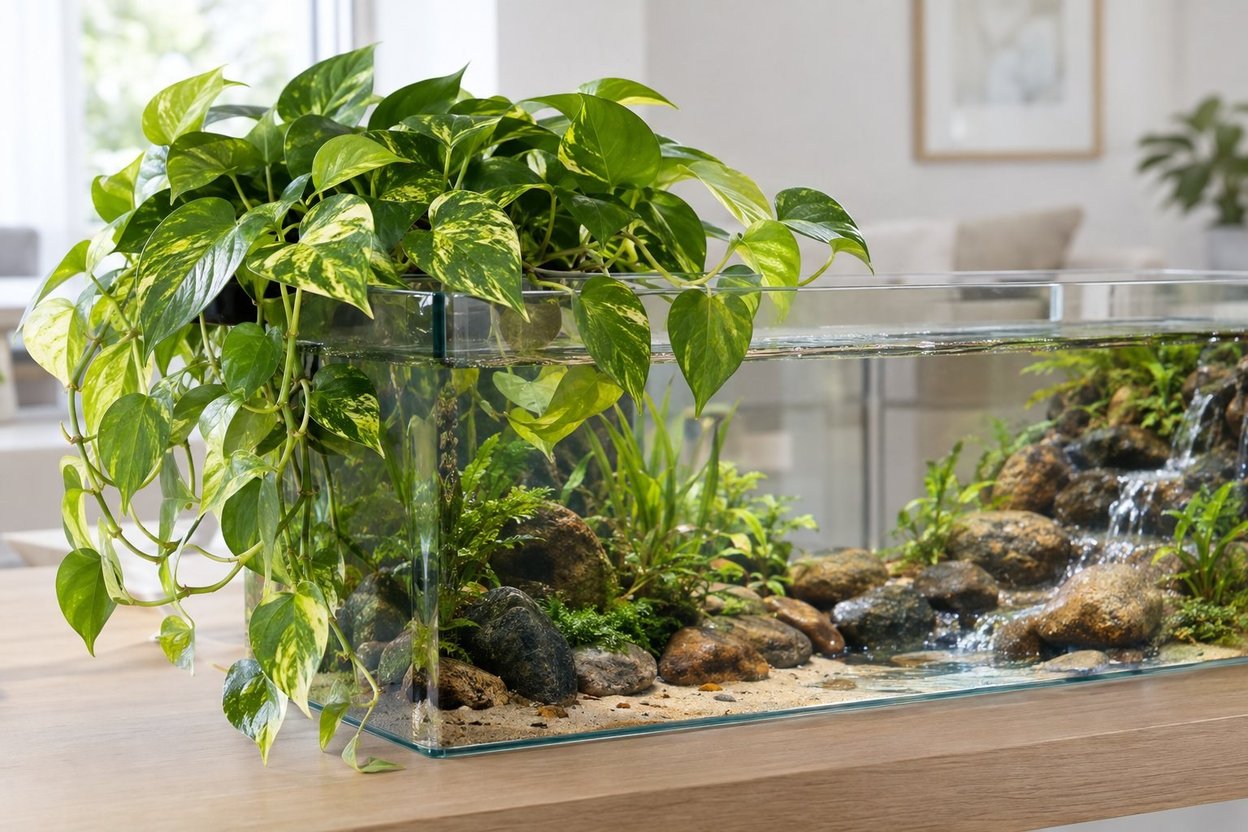
Pothos can soak up some nitrate and add a green bank to a river tank. Learn how to root it, place it safely, and keep it trimmed.
Jack·8 min read·October 22, 2026
You've probably got one already: a pothos on top of the fridge or a bookshelf, trailing vines and needing almost nothing from you. You may also have looked at your tank's nitrate reading and wished something would soak it up. Pothos does that job. Wash a cutting clean, hang its roots in the water and keep its leaves in the air. It costs a few dollars, grows fast and asks for very little. It won't replace your filter or your water changes. It will pull nitrate out of the water and give a stream-style tank a green bank.
Most aquarium plants come with a shopping list: the right substrate, root tabs, strong lights and sometimes CO2. Pothos (Epipremnum aureum) skips all of that. Guidarium rates it as a beginner plant with a low light requirement, and it needs no added CO2 and no substrate. Aquarium Co-Op says it tolerates very low light, down to nearly dark conditions.
It's also cheap. Aquarium Co-Op split a single $4 pot into six to ten plantlets, and hardware stores and nurseries sell it for very little. One pot can supply several tanks.
The idea is simple: roots in the water, leaves in the air. That fits a river tank well. A stream bank has plants leaning over the water with roots trailing in the current, and a pothos hanging over the rim or tucked into the rocks looks much the same. It's also a riparium plant in the plainest sense, with roots in the water and the rest of the plant growing above it.
Pothos takes up nitrate. It is not a filter. It won't catch debris or clear cloudy water, and it doesn't replace your filter or your water changes. Think of it as extra help.
As the roots grow in the water, they take up nitrogen. Guidarium says pothos feeds mainly from the water column and quickly absorbs excess nitrate. Aquarium Co-Op says it reduces nitrate and algae growth, so you may need fewer water changes. Less nitrate also means less food for algae, which matters in a tank with a waterfall and shallow pools under a light.
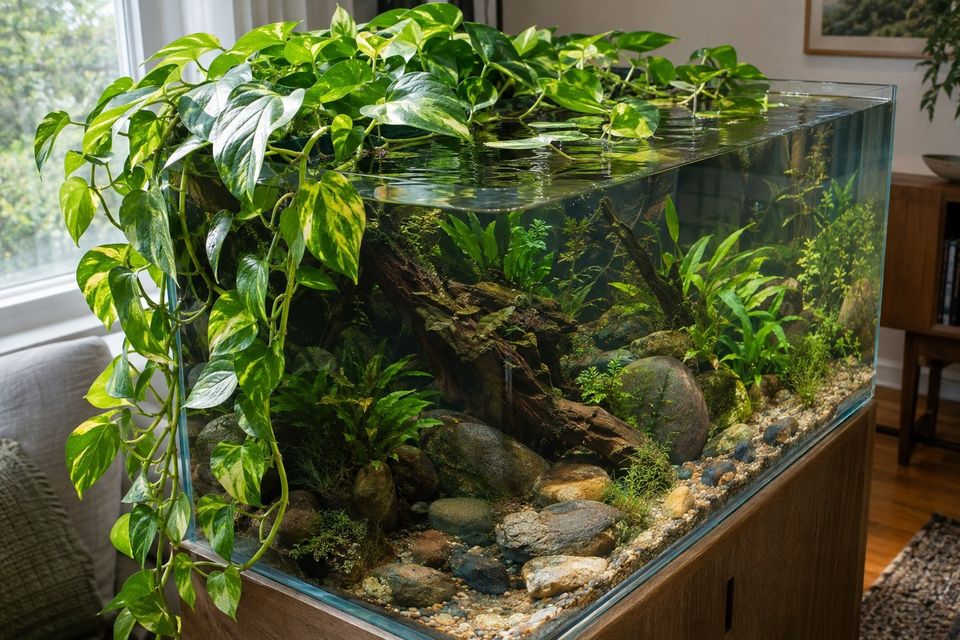
What it doesn't do is catch particles. Waste and uneaten food still have to go through your filter. Nobody has published solid numbers on how much nitrate pothos removes from a fish tank. The claims come from hobbyists, so be wary of anyone who promises a percentage or a set number of ppm.
You can measure it yourself:
If nitrate builds up more slowly between changes, you can stretch the interval a little, as long as you keep testing. If nothing changes, you've still added a cheap green plant over the water.
Start with roots if you can. Aquarium Co-Op says a single leaf can root in water, but a plantlet with roots already on it grows faster. If you're dividing a store pot, split it so each piece has two to four leaves.
Wash off every bit of soil. Rinse the roots under the tap until no dirt or potting mix is left. Potting soil often holds fertilizer, and Aquarium Co-Op warns that dirt and fertilizer can affect your water chemistry. Clean roots are the one step you can't skip.
Keep the stem and leaves dry. Only the roots go in the water. Guidarium warns that leaves left fully underwater rot, so the whole method depends on the stem and leaves staying above the surface.
You have three main ways to place it:
Mind the lid. When I set up my River Tank EcoSystem in a 55-gallon long, I learned quickly to swap the light kit for a full screen lid, because crabs and some reptiles can get out of almost anything. A vine running over the rim needs a gap, and an animal that climbs will find it. If you keep crabs, frogs or anything else that climbs, the hang-on-back filter or a stone inside the tank under a fully closed lid is safer than the rim.
Light and warmth. Give it bright, indirect light. Guidarium lists a water range of 18 to 30 °C (about 64 to 86 °F), pH 6 to 8, hardness 2 to 20 dGH, and moderate flow. A normal tropical tank falls well inside that range.
Pothos tolerates low light, but it does best with more. Clemson Extension says it prefers bright, indirect light, and that low light can fade the variegation on patterned types. Marble Queen and Snow Queen need more light to keep their white and cream markings. Neon and Jessenia handle less. If your tank sits in a dim corner, a solid-colored plant will hold up better than a heavily marbled one.
Clemson suggests days of 70 to 85 °F and nights no lower than 60 °F. As fall turns colder, don't leave the vines resting against a cold window or near a drafty door.
Pothos grows fast. Guidarium lists a maximum size of about 100 cm tall and 50 cm wide. It warns that the plant shades the plants around it and can take over the space if you don't trim it. In a river tank, a thick mat of leaves over the rim can block the light to plants in the pools and on the rocks below. Cut back long vines whenever they start to cover the water. Aquarium Co-Op says to trim the roots as needed, too, especially in a filter where they can crowd the media.
Save the cuttings. Clemson says stem cuttings root in water as long as each one has at least one node, the bump where a leaf meets the stem. Put a few in a jar of water, and you'll have rooted plants ready for your next tank or for a friend who's setting one up.
Fish. Most fish leave pothos alone. Guidarium rates it low in palatability to fish and high in uproot resistance. Aquarium Co-Op found no reports of problems in aquarium fish. If you keep plant-eaters, Aquarium Co-Op recommends putting the pothos in the filter compartment so the fish can't reach the roots. Its example is the uaru cichlid, a big plant-eating fish that could strip the roots bare.
Turtles, frogs and other reptiles. I don't have a reliable published answer on whether pothos is safe for turtles or other reptiles, or for frogs. Treat it as an open question, not a yes. If you keep these animals, use the filter-compartment method or keep the vines where they can't reach them, and watch for any nibbling. Check with a reptile vet before you assume it's harmless.
Cats and dogs. The ASPCA lists golden pothos as toxic to dogs and cats. The cause is insoluble calcium oxalate crystals, and signs include mouth irritation, drooling, vomiting and trouble swallowing. Clemson Extension also calls all parts of the plant mildly toxic if eaten. Vines hanging off a tank rim are easy for a curious cat to reach. If guests bring a dog for Thanksgiving, trim back anything hanging low.
Florida keepers. According to UF/IFAS, the Florida Invasive Species Council lists pothos as Category II in central and south Florida. It is invasive in south Florida and on the caution list in central Florida. Pieces can root wherever they land, so put trimmings in a sealed trash bag. Don't toss them in the yard or compost. That's a good habit anywhere: don't dump trimmings outdoors.
Pothos won't run your river tank for you. Still, few plants this cheap or easy help this much. Wash a cutting, put its roots in the current and keep its leaves dry, and it gives you nitrate uptake and a green bank over the water.
Skipping feeding for a four-day trip is usually safe for healthy adult fish. Learn when a feeder helps, what goes wrong, and how to prepare.
Dried oak, beech, and Indian almond leaves can tint tank water tea-brown without dye. Learn which leaves to use, how many, and how long they last.
Expanding foam can work in a fish tank if you buy pond-and-stone foam, cure it fully, and soak it before adding fish. Here's how to do it safely.