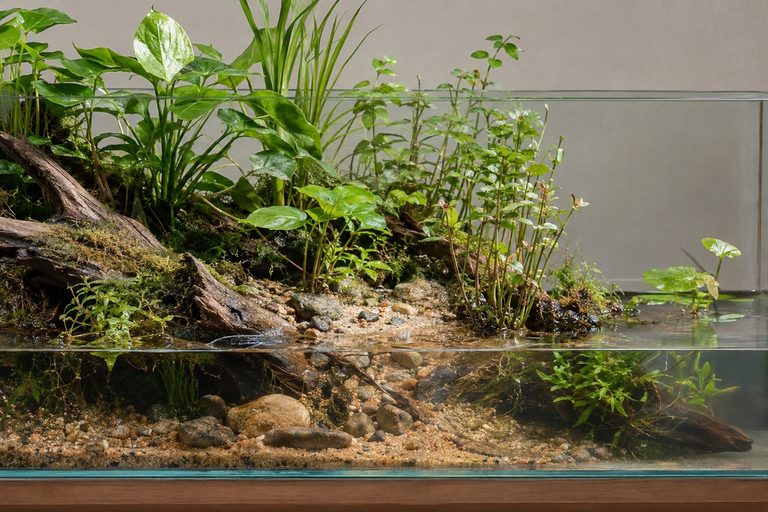
A riparium is a tank with a shoreline. What you actually need
Learn what a riparium is and what you need to build one: an open-top tank, planters, plants that tolerate wet roots, and light above the water.
Set up a riparium with rim holders for pothos, a light for leaves above water, and driftwood soaked until it sinks, plus a week-one checklist.
Jack·8 min read·October 19, 2026
You've seen a pothos vine trailing out of a tank, its roots hanging white in the water and the leaves green above it, and you've thought, I want that over my stream tank. Then you start shopping and the questions pile up. What holds the plant? How bright does the light need to be? Why does the driftwood keep floating? Here's the short version. A holder keeps the roots wet and the leaves dry. A light has to reach leaves that sit above the water. The wood has to be cleaned and soaked before it goes in. Most of that last step takes time, not gear.
A riparium, or a river tank with plants along the banks, works when three things are right.
None of this is expensive. The wood is the slow part, and it's best to start it first. If you buy your wood in early October and start soaking it now, it can be ready by Halloween or Thanksgiving, depending on the type.
There are three common kinds of holder. Most riparium planters are a cup or basket on a backing plate that sticks to the glass with suction cups or clips onto it. Some keepers make their own from a mesh basket. The third kind hangs on the rim of the tank.
The Poth-O-Carry Plus: Rail Edition from Nature Aquariums is a rim-hung holder. It hooks over the tank edge on a rail and holds pothos, lucky bamboo, spider plants, wandering jew and orchids. The listing says it lowers the plant "nearly 6"" into the tank and keeps the leaves above water. It was $17.95 when I checked on October 8, 2026. The seller says the rim holds it "far longer than any suction cup." That's the seller's claim, but anyone who has chased a suction cup that let go overnight will see the appeal. The listing doesn't give a maximum rim thickness or say what the holder is made of, so look at your tank's frame before you order.
Pothos is the easiest plant to start with. It does best with bare roots hanging in moving water, for example from a hang-on-back filter or from a holder clipped to the rim. It needs no substrate. You can also tie or wedge it against wood or stone until the roots take hold. Guidarium lists its range as 18–30 °C, pH 6–8 and 2–20 dGH, with moderate, steady flow. A normal tropical community tank falls inside all of those numbers.
One thing to plan for: a rim holder takes up the same edge your lid sits on. On my 55-gallon river tank I swapped the light kit for a full screen lid, because crabs and some reptiles will get out of almost anything. If you keep climbers, plan a cutout or gap for the holder that's too small for anything to squeeze through. Don't skip the lid.
There's no tested brightness target for leaves above the water in an aquarium. You won't find a standard PAR number, lux number or wattage. What exists is a method, and it works.
You may come across advice from an older plant book: keep lights at least 18 inches above the water so they don't burn the plants. Members of the UK Aquatic Plant Society point out that this figure probably came from the days of hot metal halide lamps, not modern LEDs. Their practical advice is simple:
One riparium keeper on the same forum hung a 36 W LED at whatever height covered the whole tank and never measured anything. For forgiving plants, that's how most people do it.
Pothos is about as forgiving as plants get. Guidarium says it "responds best to low light" and needs no CO2. That makes it a good first plant: it won't hold a so-so light against you while you're still working out the height.
If you want to know for sure, or you move on to fussier bank plants, a PAR meter is the only real measurement. Watching the leaves is free, though. The plant will show you whether the light is too strong or too weak.
New driftwood is full of air and dirt. Here's the order I'd follow:
Let the wood cool before you test whether it sinks. Hot wood can give you the wrong answer. Boiling alone also doesn't guarantee a piece will sink.
Some woods make this easy:
If a piece still floats after a good soak, anchor it:
In a river tank with a strong current, anchoring is worth doing even with wood that's close to sinking. Moving water will push a borderline piece around.
The soak times above come from sellers and hobby guides. Nobody has tested them. Go by the wood itself: when it stays down and the soak water stays clear, it's ready.
Some wood should never go in a tank:
Tannins are a different matter. The brown tint looks alarming, but it's harmless to fish. It does lower pH slightly over time, so keep testing your water. If you don't like the color, activated carbon or Purigen will clear it.
Mopani tints the longest. One Singapore retailer measured this. They found that Mopani releases tannins heavily for the first 2–3 months. A 3-week pre-soak removed about half of them and a 4-week soak about 70%. They still expected 4–8 weeks of visible tint after soaking and almost none after about six months. Their pH readings dropped from 6.8–7.2 to 6.2–6.6, but that was on Singapore tap water, so your numbers will be different. Malaysian driftwood gives off tannins more slowly than Mopani.
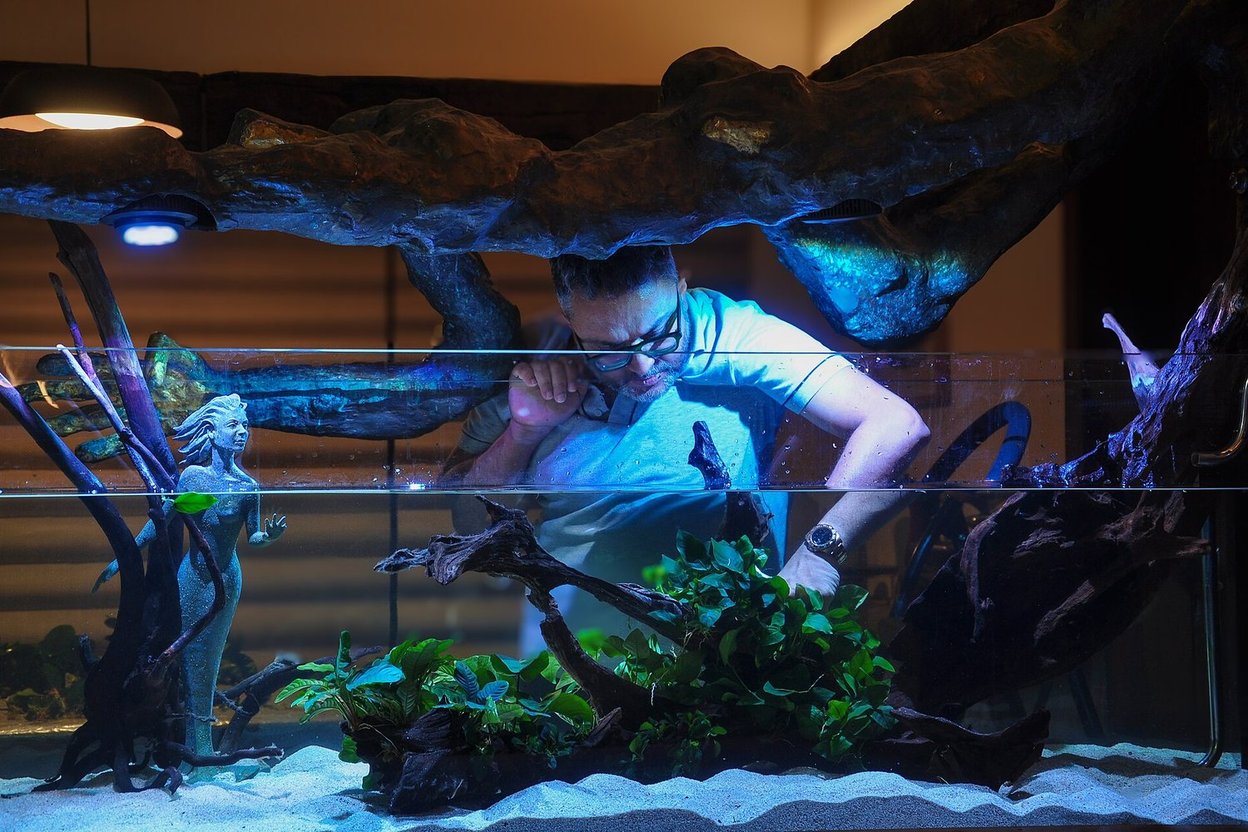
Photo: An Aquascapist Adjusting Aquarium Hardscape with Mermaid Statue by Abhik.Mazumdar.73, CC BY 4.0.
Learn what a riparium is and what you need to build one: an open-top tank, planters, plants that tolerate wet roots, and light above the water.
Learn which Halloween ornaments are safe in a fish tank, why craft-store decor is risky, and a simple screening test before adding one.
Discover why whole pumpkins damage aquarium water and how to safely offer small pieces as seasonal treats.