Bringing Aquarium Fish Home in Winter: How to Keep the Bag Warm and Steady
How to get new aquarium fish home in cold weather: buy last, use an insulated carrier, ride in the heated cabin, and acclimate slowly.
Jack·11 min read·November 23, 2026
The clerk ties off the bag, hands it over, and you look out the window at a parking lot that's 25°F with wind. The fish in that bag were sitting in water near 78°F a few minutes ago. Getting them home in cold weather is mostly about keeping the trip short and keeping the bag's temperature steady. Get the tank ready first, buy the fish on your last stop, put the bag in an insulated carrier, ride with it in the heated cabin, and use an arrival routine that fits the bag you were given.
Why a cold trip is hard on tropical fish
Most tropical aquarium fish do best around 75–80°F, though some species need something different (Aqueon). A bag holds very little water, so it loses heat quickly. University of Florida researchers who wrote about moving ornamental fish point out that in cold weather "the temperature of transport water can drop significantly," and they name swordtails, gouramis and tetras as warmwater fish that get stressed when that happens. Their guide also says that "sudden temperature changes stress the fish, suppress its immune system and can lead to disease and death" (UF/IFAS FA119).
So the danger isn't only the cold. It's the swing: the bag cools in the car, then the fish land in a warm tank. Your job is to keep the bag close to the temperature it started at.
No source gives a safe number of minutes for a bag at 20°F or 40°F, and I won't make one up. How long a bag lasts depends on the species, how much water and air is in it, how the fish were packed and how cold it really is. Here's what you can control.
Before you leave the house
Have the aquarium ready and cycled. The CDC says to set up the tank before you bring fish home and to ask about cycling it so the bacteria and nitrogen levels are balanced (CDC). If your new fish arrive at a tank that's still being set up, they end up waiting in the bag, and that waiting is the problem.
Check the heater and thermometer. Make sure the heater is holding the temperature your new species needs before you shop. Penn-Plax recommends checking heaters before cold weather sets in and keeping a spare (Penn-Plax).
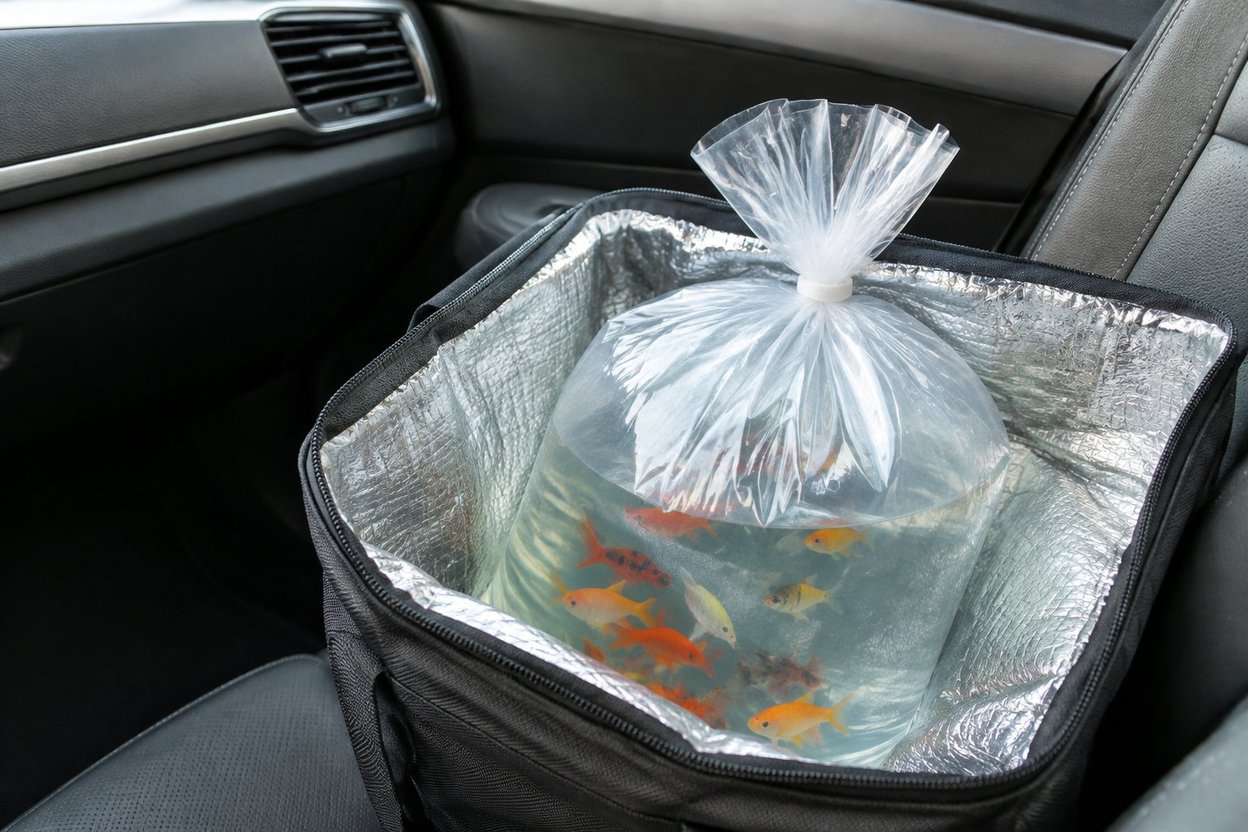
Pack your carrier. The Brooklyn Aquarium Society's winter newsletter suggests keeping an insulated picnic bag ready for winter fish and coral purchases, auctions included (BASNY, Winter 2022). An ordinary lunch cooler or picnic bag works. Aqueon also suggests coolers or Styrofoam shipping boxes for bags of small and medium fish (Aqueon).
Plan your route so the fish store is the last stop. Veterinarian Dr. Luqman Javed recommends this so the fish spend as little time in the bag as possible (Hepper). Holiday shopping trips are where people slip up. Don't buy fish and then spend an hour at the mall.
What to bring
An insulated carrier. A picnic bag, a hard cooler or a foam shipping box. Aquarium Co-Op sells an insulated tote (21 inches long by 16 inches high) made partly for carrying fish home from the store (Aquarium Co-Op). It's handy but not required. No source I trust gives a figure for how much protection any particular cooler adds, so think of insulation as slowing heat loss, not stopping it.
Filler. Crumpled newspaper or a towel to fill empty space so the bags don't roll around. The American Killifish Association recommends this for shipping boxes, and it works the same way in a cooler on a car seat (AKA).
A thermometer. Bring one if you want to check the bag water against the tank when you get home.
A battery-powered air pump (only sometimes). Aqueon recommends one for big fish or long moves (Aqueon). You don't need one for a few tetras on a 20-minute drive.
Keep rocks and other heavy things out of the carrier. Aqueon warns that anything heavy can shift and injure fish (Aqueon).
At the counter
Ask for a bigger bag or more water if the drive is long. LiveAquaria recommends asking the clerk for exactly this (LiveAquaria). More water holds heat longer and keeps waste more diluted.
Ask about double-bagging. Aqueon recommends it to protect against punctures. Aqueon's usual fill is one-third water and two-thirds air, or half water and half pure oxygen. Don't inflate a fish bag by blowing into it (Aqueon). Different sources give somewhat different ratios (Aquarium Co-Op), so it makes sense to let the store bag fish the way it normally does.
Find out what kind of bag it is. Most stores use an ordinary sealed plastic bag. Some sellers, especially ones who ship, use breathable bags, which let oxygen pass through the plastic. That difference matters when you get home (see below).
Have the carrier open and ready. Put the bag straight into the insulated bag before you walk outside, and pack filler around it.
In the car
Ride in the heated cabin, never the trunk or truck bed. STI Moving & Storage recommends putting fish where the car's heat or air conditioning can keep the temperature steady (STI Moving & Storage). U-Pack puts it plainly for household moves: fish go in your own vehicle, never in the moving equipment (U-Pack).
Warm the car up before you load the fish if it's been sitting in the cold.
Keep the carrier closed and steady. Set it on the floor or wedge it in place. Don't park it in front of a vent blowing hot air. You're aiming for steady, not hot.
Go straight home. You already planned that by making the store your last stop.
A note on heat packs
You'll see heat packs mentioned all over winter fish advice. They come mainly from mail-order shipping. UF/IFAS says winter shipping boxes can include heat packs to keep water at a suitable temperature, with the right temperature depending on the species (UF/IFAS FA120). For a short drive in a heated car, nothing says every fish needs one.
If you do use a heat pack (a long drive, a car with weak heat, or an outdoor club auction), follow these rules:
It must never touch the bag. The American Killifish Association warns that a heat pack touching a fish bag can overheat and kill the fish, and recommends a layer of paper or foam between them (AKA).
It needs air. Shipping heat packs run on oxygen, and Aquarium Co-Op notes that taping over the whole pack stops it working (Aquarium Co-Op).
How long it lasts depends on the product. Some are sold as 72-hour packs (Aquarium Co-Op). Read the label.
The pack's surface temperature isn't the temperature in the box. A hobbyist on the Aquarium Co-Op forum who tested packing setups with data loggers made this point. It's one keeper's testing, not a controlled study, but it's worth remembering before you trust a chart printed on the package (forum).
You may also hear "don't ship below 32°F." That's Aquarium Co-Op's advice for mailing fish when either end of the route is below 32°F or above 90°F (Aquarium Co-Op). It's not a rule against driving fish home in a warm car on a freezing day.
Three different trips
Most of the advice online mixes these up, so here they are separately.
A normal store purchase. Follow the steps above: tank ready, last stop, insulated carrier, heated cabin, straight home.
Moving an established aquarium. Aqueon's guide covers trips of up to a few hours. Don't feed for 24 hours before the move, keep the biological filter media wet so you don't lose your bacteria, and use a battery air pump for large fish or long distances (Aqueon). If you're setting up a stream tank with a cascade at the new place, plan for that rebuild to take longer than you expect, and keep the fish in a warm room, not a cold garage, while it's going on.
Fish that arrive by mail. Here heat packs, insulated boxes and breathable bags are normal, and the 32°F shipping guideline applies.
When you get home
First, check the bag type
Floating the bag in the tank to even out the temperature is the standard first step for ordinary sealed bags. Breathable bags are different. The American Killifish Association warns that floating them can block oxygen from passing through and suffocate the fish (AKA). If you're not sure which kind you have, ask the seller before you get home.
Matching temperature (ordinary sealed bags)
The guides don't all give the same times:
LiveAquaria: turn off the tank lights, dim the room, and float the sealed bag for 15 minutes (LiveAquaria).
Petco's 2013 guide: float at least 15 minutes and no longer than an hour, and match bag and tank temperatures before moving on (Petco).
CDC: float the unopened bag for roughly 30–60 minutes (CDC).
A cold trip is the reason to check with a thermometer instead of watching the clock. If the bag got noticeably cold, take longer. UF/IFAS's guide for fish farms says that when temperatures are far apart, acclimation should happen slowly, over two or more hours (UF/IFAS FA119). That guide was written for commercial transport, so treat it as a sign of how slow is safe, not a fixed recipe.
Moving the fish into the tank
There's real disagreement here. LiveAquaria says to net the fish out and throw away the transport water (LiveAquaria). The CDC warns against small nets because they can injure fish, and says to release the fish with as little bag water as possible (CDC). Both are trying to keep store water out of your tank. They just weigh injury risk differently. Pick one, and either way don't pour the whole bag in.
Afterward
Keep the tank lights off for at least four hours after adding the fish (LiveAquaria).
Quarantine is a separate step, and the recommended length varies. LiveAquaria suggests two weeks (LiveAquaria), and Hepper's veterinarian recommends at least four weeks, ideally six (Hepper). In a mixed tank like the river tanks this site is about, where fish share space with crabs or frogs, a slower quarantine is the more careful choice.
Signs the trip was too cold
Petco lists these possible signs of temperature stress (Petco):
Rapid gill movement
Clamped fins
Loss of color
Erratic swimming
Loss of appetite
A little hiding and pale color in the first few hours is common with new fish. If the signs last, Petco recommends getting help from a vet who treats fish.
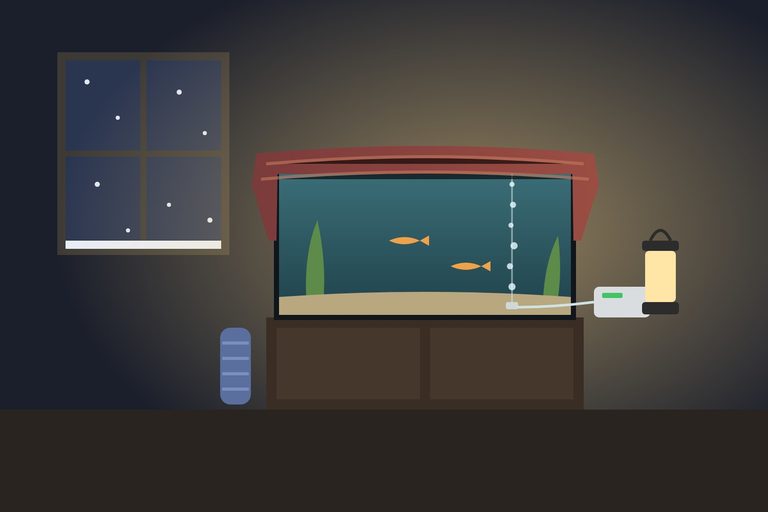
The same cold that makes the drive tricky can also knock out your power. NC State aquatic veterinarian Gregory Lewbart recommends wrapping aquariums in blankets, sleeping bags or newspaper during winter outages and watching the temperature with a thermometer (NC State). The cooler and towels you use for the drive home work for that too. With a spare heater on the shelf, as Penn-Plax suggests, you're covered for the whole season.
I've had fish tanks since I was a kid, and the part of this I'd stress most is the step before the store: a tank that's cycled, heated and ready, so the fish come out of the bag the moment they get home.