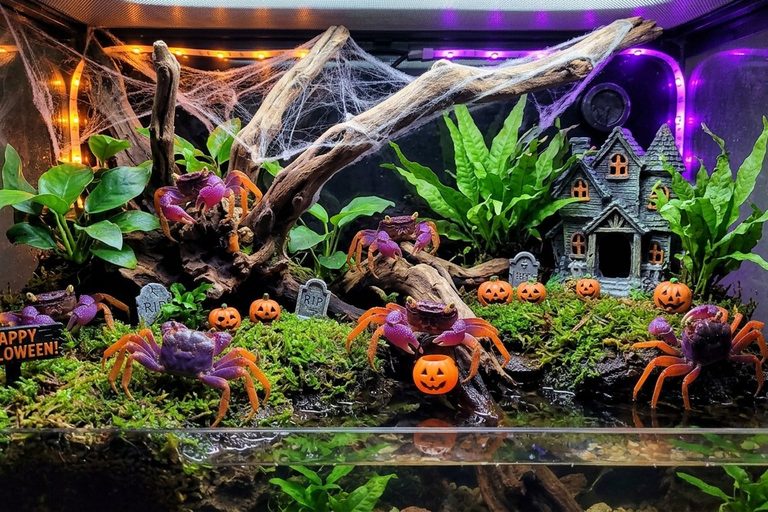
Can a crab get stuck in a pumpkin-house ornament?
Can a crab get trapped in a pumpkin-house ornament? See which openings are risky, how to pick or seal a safe piece, and how to free a stuck crab.

Most crabs can't swim well. Learn which crabs have paddle legs, which only walk, and which land crabs can drown.
Jack·7 min read·June 10, 2021·Updated October 15, 2026
If you've waded off a dock or a beach and watched a crab shoot past just under the surface, you've seen a real swimmer. Many crabs never do that. Whether a crab can swim depends mostly on one detail: the shape of its back legs. Some crabs have paddles there and swim well. Many others only walk along the bottom. A few land crabs will drown if they stay underwater too long. Here is how to tell them apart, and why the crab you picture first may not be a crab at all.
The best swimmers belong to the family Portunidae, which is why they are called swimming crabs. Their swimming gear is not the claws. On most portunids, the fifth and hindmost pair of legs is flattened into broad, oar-like paddles. The claws handle feeding and defence. The three pairs of legs in between do the walking, on the seafloor rather than on land.
Even in this family the paddles vary. A 2006 paleontology study by Schweitzer and Feldmann noted that not every portunid has paddle-shaped back legs, and that the paddle's form differs between subfamilies. So "swimming crab" describes a body plan that most of the family shares, not a rule that covers every species.
The blue crab of the Atlantic coast is the best-known swimming crab. Its scientific name, Callinectes sapidus, roughly means "savory beautiful swimmer." South Carolina's Department of Natural Resources says it walks sideways on three pairs of thin legs. It swims by sculling its oar-like fifth pair, sweeping the paddles through the water rather than kicking. NOAA Fisheries and the Chesapeake Bay Program both describe those rear legs as paddle-shaped swimming legs.
The Chesapeake Bay depends heavily on this crab, and its numbers are watched closely. The 2026 Winter Dredge Survey, run by Maryland DNR with the Virginia Institute of Marine Science, counted about 349 million blue crabs. That is up 46% from 238 million in 2025, the second-lowest total since the survey began in 1990. Juveniles rose about 121% to roughly 228 million, which ended six straight years of below-average young crabs. Adult females fell about 25% to 81 million. That is still above the 72.5 million safety threshold but well short of the 196 million target.
Crabs without paddles mostly stay on the bottom.
Fiddler crabs are walkers. When the tide comes in, they shelter in burrows instead of swimming. One National Park Service source says they plug the entrance with sand, which traps a pocket of air inside. In aquariums they move along the bottom rather than through open water. No study we know of has measured adult fiddler crab swimming directly, so "they don't swim" is the common view rather than a tested fact. Their famous oversized claw has nothing to do with it. Only males have one, and they use it to attract females and threaten rivals. Females have two small claws of equal size.
Spider crabs are a closer call. Most spider crabs in the family Majidae are slow bottom-dwellers and poor swimmers. Still, "spider crabs can't swim" goes too far. A 2020 note hosted by NOAA reported a Platymaia spider crab swimming in the wild, using its long legs to rise about 2 meters off the bottom. That genus is placed in a related family, Inachidae, so it is better described as an exception among spider-like crabs than as proof that majids swim.
Some crabs have moved onto land so completely that deep water is dangerous to them.
The coconut crab is the extreme example. It is the largest living land arthropod, weighing up to 4.1 kg (about 9 lb) with a leg span of more than 0.91 m (about 3 ft). It lives on islands across the Indian and central Pacific Oceans, from Zanzibar east to the Gambier Islands. The largest and densest population is on Christmas Island. Adults cannot swim and drown if kept underwater too long, which Wikipedia puts at more than an hour. The reason is not that they lack gills. They breathe with branchiostegal lungs, which are gill-like tissue adapted to take oxygen from air, and they still keep reduced, vestigial gills. The IUCN lists the species as Vulnerable, mainly because of habitat loss and hunting.
Land hermit crabs, the kind sold as pets, are not swimmers either. In shallow water they walk along the bottom, and they can drown. One general marine-life site says this happens after roughly 15 to 30 minutes underwater. Treat that as a rough estimate, not a measured limit.
These land crabs still begin life in the sea. Coconut crab larvae drift in the ocean for about three to four weeks before coming ashore. Fiddler crab larvae are free-swimming too. Many crabs that never swim as adults spent their first weeks in open water.
If you've seen a crab-shaped animal swimming belly-up, it was probably a horseshoe crab. Horseshoe crabs are not true crabs. They are related to spiders and scorpions. They do swim upside down, at an angle of about 30 degrees to the bottom. This is their normal way of swimming, not a panic response, and juveniles do it often. Along the U.S. Atlantic coast, the Atlantic States Marine Fisheries Commission has managed horseshoe crabs under an interstate fishery management plan since 1998.
Swimming crabs, walking crabs, and land crabs share one habit: they scuttle sideways. A 2026 study, published as an eLife reviewed preprint, filmed 50 crab species. It suggests sideways walking evolved once in true crabs, about 200 million years ago, and that some lineages later went back to walking forward. The authors propose that moving sideways helps crabs escape predators because their direction is harder to predict. The study is still a preprint, so treat its conclusions as a strong hypothesis rather than settled science.
The short answer, then: crabs with paddle-shaped back legs, like the blue crab, swim well. Most others walk the bottom. A few land crabs can drown. If the animal is swimming upside down, it isn't a crab.
Can a crab get trapped in a pumpkin-house ornament? See which openings are risky, how to pick or seal a safe piece, and how to free a stuck crab.
Vampire crabs make tempting Halloween impulse buys at $10, but they need a land-heavy paludarium to survive—not a traditional fish tank.
Tell snail eggs apart by species (nerite dots, mystery snail clutches, ramshorn and bladder jelly) and decide whether to scrape, keep, or hatch them.