Can a crab get stuck in a pumpkin-house ornament?
Can a crab get trapped in a pumpkin-house ornament? See which openings are risky, how to pick or seal a safe piece, and how to free a stuck crab.
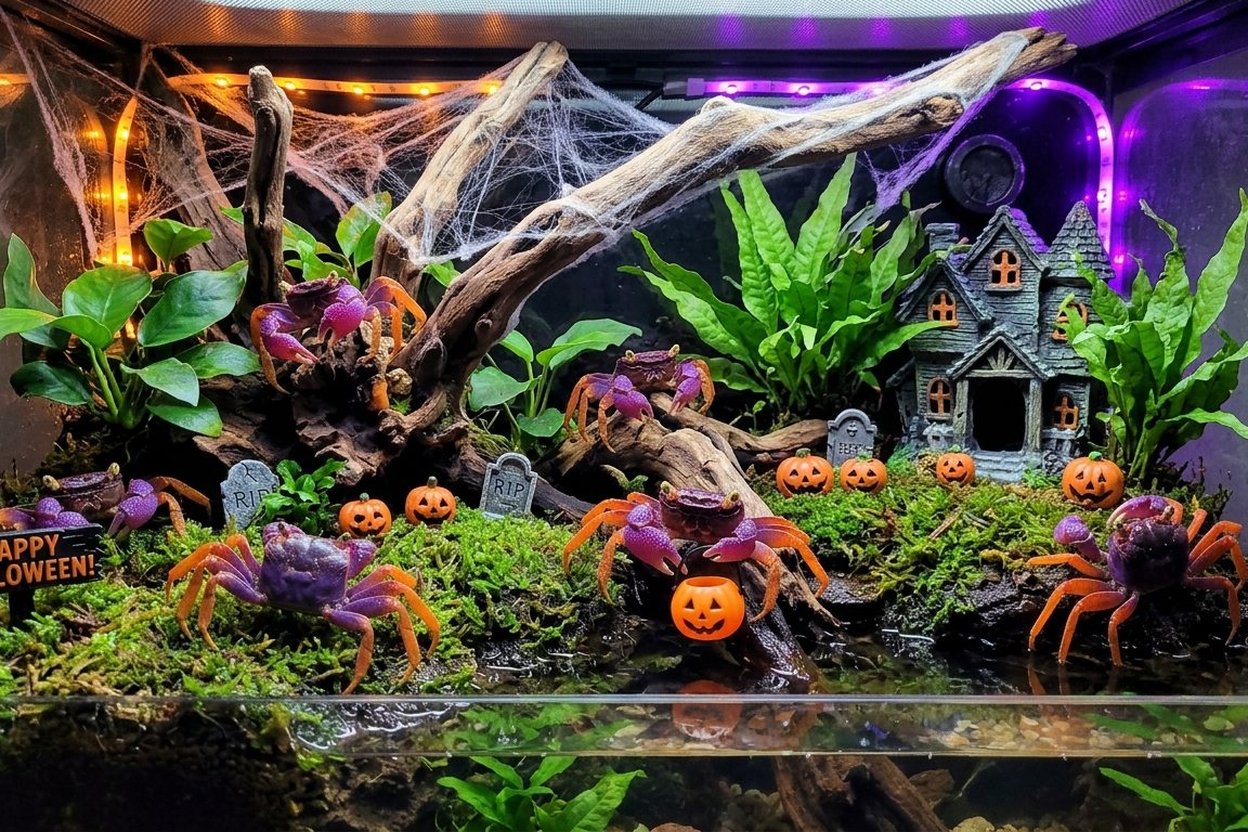
Vampire crabs make tempting Halloween impulse buys at $10, but they need a land-heavy paludarium to survive—not a traditional fish tank.
Jack·9 min read·October 8, 2026
You're in the fish aisle in early October, picking up dechlorinator, and you see a small purple crab with bright yellow eyes. The sign says "vampire crab," the price is about ten dollars, and Halloween is a few weeks away. Should it go home with you and into your tank? If your tank is a fish tank or a river tank, the answer is no. A vampire crab is a fair pet only after you have a land-heavy paludarium built and running, set aside for one crab species, and you buy knowing where these crabs come from.
The low price and the spooky name are what make this an easy mistake. On 7 October 2026, PetSmart listed a live "Vampire Crab" at $9.99, in-store only. The same page rates it "intermediate" for experience level and "aggressive" for behavior. It also showed an October sale banner and an offer of extra loyalty points on invertebrates through 18 October. Aquatic Arts, a specialist seller, listed Geosesarma dennerle at $29.99 and warned buyers that the crab is semi-terrestrial and doesn't belong in a traditional aquarium.
The cheap tub usually doesn't tell you that. A 2026 University of Plymouth survey of land-crab ads found prices from £5 to £120, and most listings gave little or no care advice. PetSmart will replace the animal or refund you if it gets sick in the first 14 days. But a second crab dropped into the same wrong tank will have the same problem as the first one.
These crabs don't drink blood. They are small land crabs from Southeast Asia in the genus Geosesarma. They're nocturnal, and the "vampire" name comes from their glowing yellow eyes and their look. Two of the best-known ones had been in the pet trade for years before scientists named them. In 2015, Peter Ng, Christoph Schubart and Christian Lukhaup described G. dennerle and G. hagen from two streams near Cilacap in Central Java, about 10 km apart. Both were named after aquarium companies that supported the work: Dennerle and the Rolf C. Hagen group.
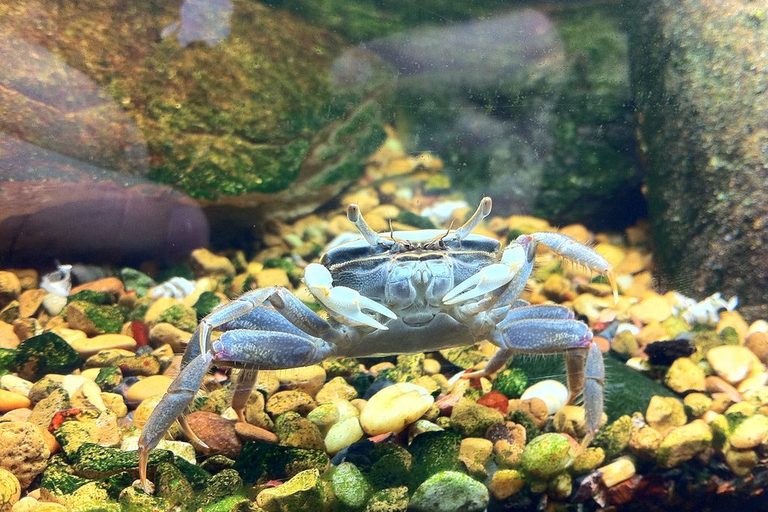
They are tiny. The G. dennerle holotype's shell is 14.4 mm wide. G. dennerle has purple claws, purple legs and a purple front shell, with a cream to yellow-white rear shell. G. hagen has reddish-orange claws on a dark body that can be almost entirely orange. Before the paper came out, dealers said the crabs came from Sulawesi, Krakatau, the Riau Islands and other places. Collectors had a reason to keep the real streams hidden.
Shop names are still messy. A 2026 trade survey found that "vampire crab" was used for Geosesarma in general, not for one species, and that G. dennerle alone was sold under 14 different common names. Aquatic Arts sells the purple crab as G. dennerle and a separate orange "Halloween" crab under G. bicolor. G. bicolor is a real species described in 1995. You can't tell from the price tag which crab you're actually getting.
In the wild, G. dennerle lives under and between rocks in vegetation on the slopes of a small valley. It eats grasshoppers, larvae and plant debris. Only the juveniles stay close to the waterline. These crabs live on the bank, not in the current. PetSmart says they spend most of their lives on land but still need water they can fully submerge in. Petco warns that they drown if they can't easily climb out. Aquatic Arts says plainly that they must not be kept as fully aquatic animals. Both chain-store care sheets call for humidity of 75% or higher, which an open fish tank won't hold.
My old river tank was a 55-gallon long. Water was pumped up on the left and ran down through three pools. That design works for fish and fails for this crab: it's mostly water, it has deep pools, and moving water is the whole point. One thing I learned fast with that tank was to replace the light kit with a full screen lid, because crabs get out of almost anything. Petco calls vampire crabs escape artists, and PetSmart puts a tight-fitting lid first on its shopping list.
The tankmates are a problem too. PetSmart sells the crab in its live-fish department, yet its own care guide says the crabs prey on snails and may injure fish. Aquatic Arts says most fish, frogs and reptiles are poor tankmates.
Before you pay for a crab, this setup should already be running:
Don't plan around the size on the shop sign. PetSmart says about 2 inches across the body, and Aquatic Arts says 1–1.5 inches. The scientific specimens measure about 14 mm across the shell. The bigger shop numbers probably count the legs or are just inflated, so expect a crab whose shell is about the size of a fingernail.
They do best in a group, but the males fight over territory. All three sellers agree on one rule: keep only one species. Mixing species leads to fights and breeding problems, and PetSmart says the crabs prey on similar species. The sellers disagree on how many males can share a tank. Aquatic Arts says more than one can work in a large tank with lots of hiding places. Petco says one male with a couple of females. The cautious start is one male with two or more females, plenty of cover, and a backup container ready in case you need to separate one.
The advice on shrimp conflicts too. PetSmart says small ghost shrimp often do fine. Aquatic Arts rates the crabs as not shrimp-safe, with very high predation on baby shrimp. I'd count shrimp as food. The good neighbors are springtails and isopods in the land area, which both sellers recommend. Fish, frogs, snails and reptiles from a river tank are all poor matches. Also, don't handle the crabs. Petco warns that even a short fall can kill one.
Their bright color got them exported before anyone knew which streams they came from. In 2015, Ng told Live Science that over-collection could threaten a small crab with a restricted range. The 2026 Oryx survey covered 574 ads from 15 sellers in the UK, the US and continental Europe: 23 species under 61 common names. Geosesarma made up 210 of those listings, and G. dennerle alone made up 65. None of the species was on a CITES appendix, and 19 had never been assessed for the IUCN Red List. None of the 574 ads said whether the crabs were captive-bred or wild-caught.
Ella Whitaker, the PhD researcher on the study, calls these crabs ecosystem engineers. She says that with no regulation, nobody knows what removing them from the wild does. Lucy Turner, the senior author, warns the trade could be a serious threat to wild populations. Her lab is working on captive breeding to take pressure off wild stock.
Captive breeding is realistic for these crabs. The 2015 paper describes a female carrying large eggs with visible eyes. Aquatic Arts says the young hatch as fully formed crabs, with no larval stage that needs salt water. So ask the seller whether the crabs are captive-bred, and if they can't say, take that as a warning. Check your state's laws as well. Aquatic Arts won't ship to Maine because state law blocks importing wildlife that isn't on its approved list.
Petco stocks vampire crabs at select stores only, so call ahead. Its care sheet rates them "beginner," while PetSmart rates the $9.99 crab "intermediate." I'd go with the more cautious rating. If the tank on this list doesn't exist yet, put the crab back. It'll still be for sale after Halloween.
Can a crab get trapped in a pumpkin-house ornament? See which openings are risky, how to pick or seal a safe piece, and how to free a stuck crab.
Tell snail eggs apart by species (nerite dots, mystery snail clutches, ramshorn and bladder jelly) and decide whether to scrape, keep, or hatch them.
CPO dwarf crayfish care: size, temperature, safe tank mates, molting, breeding, how much flow they like, and the states where you can't buy them.