How to Keep Christmas Guests From Overfeeding Your Fish
Keep holiday guests from overfeeding your fish with one designated feeder, pre-measured portions, a written card, and a calm plan if extra food gets in.
Room sprays and artificial snow can harm fish. Learn what's risky, how to decorate safely, what warning signs to watch for, and what to do after a spill.
Jack·7 min read·November 20, 2026
You're hanging lights after Thanksgiving, someone grabs a can of spray snow for the window, and the fish tank is three feet away. Or a pine-scented room spray goes off right beside the open top of a riparium. Can that hurt your fish? Yes, it can. Aerosol sprays can be toxic to fish, so keep room sprays and snow cans out of the aquarium room. One accidental squirt doesn't mean the fish were poisoned or that any will die, though. Below I cover what's in these products, how to decorate safely, which signs to watch for, and what I'd do after an accident.
The plain answer is caution. Aquarium welfare guidance warns that aerosol sprays can be toxic to fish. It also advises against using air fresheners near a tank unless the manufacturer confirms they're suitable around fish (RSPCA, Practical Fishkeeping). That's a good enough reason to do your spraying in another room.
How much harm a spray does depends on the formula and on how much of it reaches the water (Poison Control). Nobody can tell you from "someone sprayed something near the tank" whether your fish will be fine. Aquarium advice doesn't fully agree either. One Practical Fishkeeping answer is cautious but fairly reassuring about air fresheners. A longer feature from the same magazine warns that chemicals can build up in tank water over time. Neither one gives a safe level.
Artificial snow is the murkier case. The general warning about aerosols applies to spray-on snow because it comes out of a pressurized can. I don't know of any aquarium testing of snow products, so treat everything here about snow as a precaution, not a proven danger.
"Christmas spray" covers at least three very different things:
Poison Control treats spray-on snow and water-expanding powders as separate products with different hazards (Poison Control).
Here's one real formula. Chase's Santa Snow lists water, calcium carbonate, sorbitan tristearate, propane, butane, sodium nitrite and oleic acid (Chase Products). That's one product, not a recipe every brand shares. Its safety data sheet, dated September 21, 2022, has an ecological section with no fish-toxicity figure at all (SDS). The sheet says nothing either way about a safe dose for an aquarium.
Poison Control's guidance on artificial snow is fairly calm, but it's about small exposures in people, like a child getting a little on their skin or in their mouth. A fish lives in the water it's exposed to and breathes it through its gills, so that guidance tells you nothing about what a fish can handle.
Labels like "non-toxic," "water-based" and "contains no solvents" are not aquarium-safety ratings either. If you want to know what's in a can, find the exact product, read the label, and look up its safety data sheet. Don't assume this year's snow can matches last year's.
My best advice is to frost and scent things somewhere else. Spray snow on the wreath, the window stencil or the centerpiece in the garage or another room. Let it dry there, then bring it in. Keep the snow itself out of the aquarium. That includes snow on decorations, on the hood, and in a riparium's planted top. I can't promise dried snow is safe in water, so I wouldn't put it there.
A lid helps. RSPCA guidance notes that a cover can keep out some airborne pollution (RSPCA). The key word is "some." When I ran my 55-gallon river tank, I replaced the light kit with a full screen lid because crabs and some reptiles will get out of almost anything. A screen keeps animals in, but it won't stop a mist from drifting through. Don't treat a lid as permission to spray next to the tank.
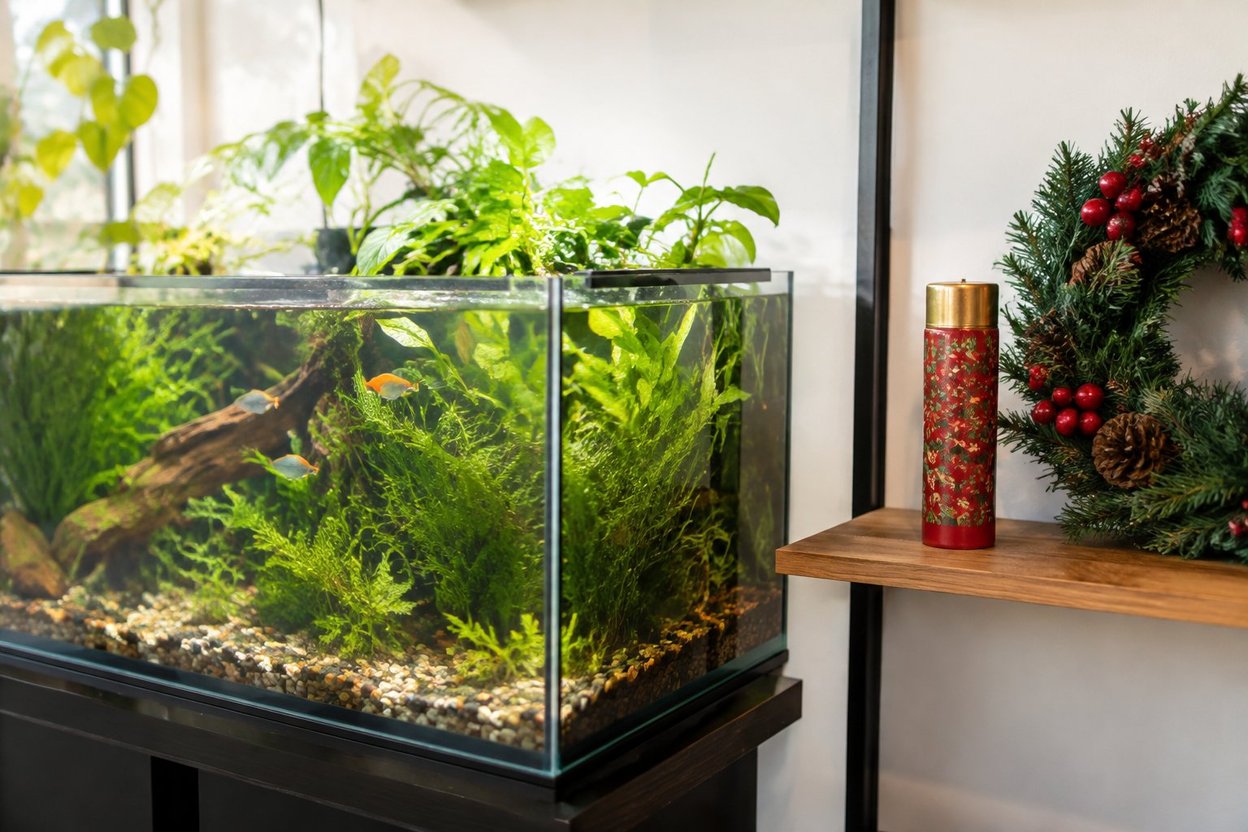
Open-topped ripariums and river tanks have the most exposed water, so they need the most care. Store water conditioner, nets, buckets and test kits where nobody will spray. If you've just put on scented lotion or perfume, keep your wrists out of the tank. Practical Fishkeeping specifically warns about fragranced skin going into the water (Practical Fishkeeping).
Bug spray is a separate and more serious problem. Permethrin, a common insecticide, is highly toxic to fish (EPA, Pet Poison Helpline). Never use one near a tank.
Watch the tank closely for the rest of the day. Signs that can go along with poisoning include:
None of these proves the spray did it. Gasping can also mean low oxygen or poor water quality (Practical Fishkeeping, RSPCA). Holiday tanks often have other things going on, like a missed water change, overfeeding by visiting relatives, or a heater that's struggling in a drafty room.
So test the water. Ammonia and nitrite should both read 0 mg/L (RSPCA). A clean result rules out the common causes. Keep in mind that a normal aquarium test kit won't detect fragrance chemicals, so a clean reading doesn't clear the spray.
If I thought a spray or snow had gotten into a tank, this is what I'd do:
Some limits are worth knowing. There's no proven water-change percentage or carbon schedule for room spray or artificial snow. Anyone who gives you a fixed recipe is guessing. Carbon helps, but it isn't a guaranteed fix. In my opinion, a big change followed by watching the fish, testing, and changing more water if needed beats one heroic dump-and-refill.
Protect your biological filter media while you do this. Don't rinse it under the tap, because chlorinated water can kill the bacteria that keep ammonia and nitrite at zero. If you have to rinse it, use old tank water (RSPCA). An emergency clean-up isn't the same as routine maintenance. The goal is to get the contaminant out without crashing the tank's cycle.
The simplest fix comes before any of this. This fall, while you're digging out the decorations, set a house rule that no sprays go in the tank room.
Keep holiday guests from overfeeding your fish with one designated feeder, pre-measured portions, a written card, and a calm plan if extra food gets in.
Most store-bought ornaments aren't safe underwater because of paint, glitter, and metal. Learn what to buy instead and how to test one first.
Loud parties can stress fish through tank vibration and tapping. Here's what research shows and a quick checklist to protect your tank.