Can You Put a Small Christmas Tree Ornament in a Fish Tank
Most store-bought ornaments aren't safe underwater because of paint, glitter, and metal. Learn what to buy instead and how to test one first.

Loud parties can stress fish through tank vibration and tapping. Here's what research shows and a quick checklist to protect your tank.
Jack·5 min read·November 20, 2026
When you set the playlist and welcome holiday guests, the tank may be only a few feet from the speakers. A loud gathering can stress aquarium fish, especially when bass or sudden impacts vibrate the tank, though a few hours of music is unlikely to harm healthy fish. You can reduce the disturbance with a few simple changes and keep an eye on your fish afterward.
Sudden or sustained loud noise can stress fish, but the evidence for lasting harm from one evening is limited. Fish detect vibrations through water; room sound reaches them when it makes the tank vibrate. Most freshwater fish hear frequencies of roughly 50 to 2,000 Hz, and sudden loud sounds can raise cortisol, a stress hormone.
The studies involve only a few species, so they cannot predict exactly how fish in a typical home aquarium will respond. A few hours of music is unlikely to harm healthy fish.
The party-day problems you can prevent most directly are:
Noise, abrupt light changes, and busy activity around the aquarium can add to the disturbance. Give your fish places to hide, and keep the aquarium light on its normal schedule or dim it if the room gets rowdy.
The available studies point in different directions, and none tested a home aquarium during a party.
A 2020 study tracked Gulf toadfish in hatchery tanks near the three-day Ultra Music Festival in Miami in 2019, which drew about 50,000 people. Airborne sound at the hatchery stayed below about 72 dBA, while low-frequency sound inside the tanks rose by 7 to 9 dB. The fish’s blood cortisol rose four to five times on the first night. That response exceeded the one measured after a simulated predator chase and resembled the response to bottlenose dolphin sounds. The authors described the result as preliminary; they could not determine whether the festival caused long-term harm.
A 2007 conference paper followed 32 lined seahorses housed alone for a month in tanks with loud or quiet circulation pumps. Loud-tank seahorses lost more weight and body condition and showed signs of immune suppression. They piped and clicked more by week four. They were most restless in week one, then habituated. The authors called pump noise a chronic, subtle stressor and recommended soundproofing.
In a zebrafish study, random tapping hard enough to startle the fish did not significantly change cortisol; food deprivation did. Each set included six fish. Together, the findings show that noise effects depend on the sound and exposure, with no direct test of a living-room gathering.
Glass tanks transmit room vibration into the water, so bass thumps and nearby impacts deserve your attention.
In the toadfish study, low-frequency sound increased by 2 to 3 dB in the open channel and by 7 to 9 dB inside the hatchery tanks. Water carries sound about four times faster than air, at roughly 1,480 meters per second compared with 343 meters per second. A tank on a shared speaker shelf or against a wall with a subwoofer can pick up repeated vibration.
Sudden impacts, such as tapping the glass, slamming a door, or dropping an item nearby, can startle fish. About 12.5 million U.S. households have freshwater aquariums, and 2.5 million have saltwater aquariums. If guests include children, ask them to stay hands-off around the glass.
A few practical checks help you avoid preventable disturbance and equipment problems.
Hiding, clamped fins, gasping, dashing around the tank, or refusing food can signal stress.
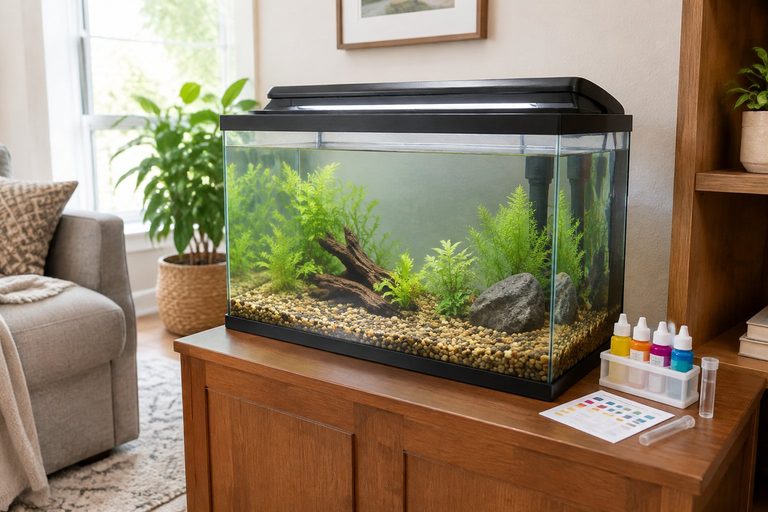
If you notice a behavior change, test ammonia and nitrite promptly. Keep up with regular water changes and filter cleaning through the holidays, and maintain nitrate below 40 to 50 ppm according to your fish’s needs. Shy bottom-dwelling fish in a river-style tank need cover, as do fish adapted to fast-moving water.
Once the room is quiet, noise-related stress usually passes. Keep watching for changes in breathing or behavior, and check the water if those signs persist.
Plan for one evening of guests, not a prolonged period of pump-like noise. The low-cost precautions are straightforward: keep bass away from the tank, discourage tapping, and confirm the heater and other equipment remain on. After the gathering, give the room time to quiet down and observe your fish before changing their routine.
Most store-bought ornaments aren't safe underwater because of paint, glitter, and metal. Learn what to buy instead and how to test one first.
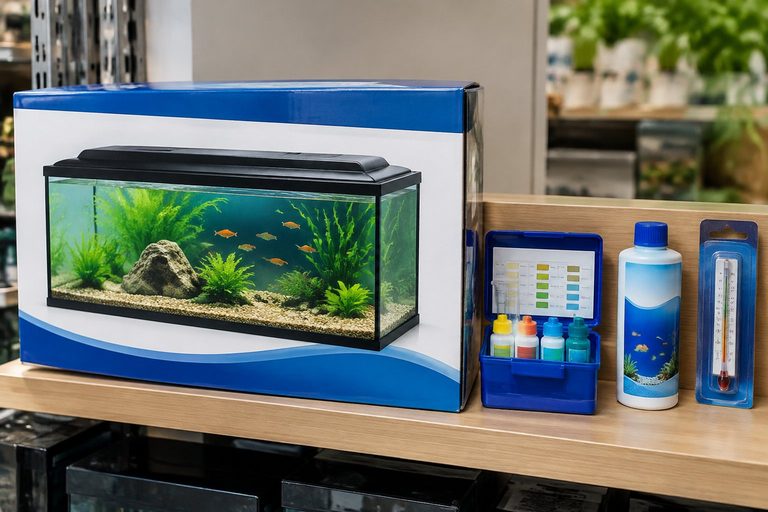
The best beginner aquarium gift: a 20-gallon kit, liquid test kit, conditioner and thermometer. Skip the fish and explain why in a note.
A fish tank makes a good first-timer gift if you plan the cycle. Get the timeline, the must-have kit, and what to put in the box.