How Many Times an Hour Should Aquarium Water Turn Over?
How many times an hour your filter should turn over your tank's water, with GPH math, river-tank targets, and why box ratings overstate flow.
Heating vents and radiators can push your tank's temperature past what the heater controls. Learn why to avoid them and how to test a spot.
Jack·7 min read·October 27, 2026
It's October and the furnace kicks on for the first time this season. You hear the click and the rush of air, and the warm air blows right across the spot where you planned to put the new tank, or where the tank already sits. So can a fish tank go next to a heating vent or radiator? Try not to. Here's what the heat does to the water, what other keepers have seen happen, and how to make it work if there's truly no other spot.
Don't set a tank right against a floor register, a wall vent or a radiator. On this point the aquarium care guides all say the same thing. LiveAquaria says to keep tanks away from heating and air conditioning vents because they "can drastically alter the temperature in the immediate surrounding area." Charterhouse Aquatics, a UK retailer, names radiators, fireplaces, wood burners, heating vents and portable heaters, because they "can cause unnecessary temperature fluctuations" and make it harder for your aquarium heater to hold a steady temperature.
Fluctuation is the important word. A tank that sits at one steady reading is usually fine. The trouble comes when the temperature climbs every time the heat runs and drops when it shuts off. Both guides say the same thing in nearly the same words: LiveAquaria says "stable water temperature is imperative to fish health," and Charterhouse says "stable temperatures are vital for healthy fish."
Start with the numbers. The air coming out of a forced-air register is much warmer than the room. One HVAC service company puts typical register air at about 120–140°F. A home-inspection reference gives a lower figure of about 100–110°F and says duct length, insulation and leaks all change it. So figure on roughly 100–140°F depending on your system. Turning up the thermostat doesn't make that air any hotter. The furnace just runs longer, so a tank in the airflow gets heated for longer.
Radiators are hotter still. One keeper on an older fish forum put the water inside a typical radiator at around 60–70°C (140–160°F), in a room sitting at 23°C (73°F).
Compare that with a tropical tank, which usually runs somewhere in the 70s °F. Air or metal that hot, a few inches from the glass, heats up one side of the tank. Your aquarium heater has no idea that's happening. It's a thermostat: it switches on when the water near its sensor drops below the set point and off when it's reached. It can add heat, but it can't take any away. When a radiator or vent is also warming the water, the tank goes above whatever you set the heater to. A moderator on a UK fishkeeping forum gave that exact explanation, and added that a degree or two of normal swing is expected with any thermostatic heater. The vent or radiator pushes it well past that.
Oxygen is the second problem. Aqueon notes that "the ability of water to hold dissolved oxygen drops with rising temperature." At the same time, fish burn more oxygen as the water warms. So a heat spike leaves less oxygen in the water just as the fish need more.
What follows comes from forum keepers, not from controlled tests. I'm not aware of any vet or university study that measures how much a radiator or vent warms a tank at a given distance. Read these as experiences, not rules.
In a 2006 thread on FishProfiles, someone planned to put a tank about 5 inches from a radiator. Every person who replied told them not to. One said it would "very quickly cause your tank to overheat." The original poster moved the tank.
A keeper on a UK forum described what happens when it goes wrong. Their tank sat beside a radiator and peaked just over 30°C (86°F), with swings of 7–8°C (roughly 13–14°F) over the course of a day. The fish died. Their explanation was that the side near the radiator warmed unevenly, and the heater's sensor sat on the cooler side and couldn't tell.
Other keepers report no trouble at all. In a reef-keeping thread, posters said 3–4 feet from a heater was "not too bad," while 3–4 inches was something to avoid. One said their 75-gallon tank sat right against a radiator with no problems.
The difference between these stories mostly comes down to two things. One is distance: inches is very different from feet. The other is tank size. A big volume of water changes temperature slowly, while a small tank can swing quickly. Even so, nobody can give you a safe distance that holds for every home, so test your own spot.
Sometimes the only wall with room for a 55-gallon is the one with the register. If that's your situation:
Keep checking through the holidays too. If the thermostat gets turned up when the house fills with people around Thanksgiving, read the thermometers that weekend.
Heat sources aren't the only problem. LiveAquaria warns that direct sun "can encourage aggressive algae growth, as well as increased water temperatures," and Charterhouse notes that sunlight can warm a tank quickly, especially in summer. Cold is a problem as well. Charterhouse says to avoid exterior doors, windows that get opened a lot, and AC units, because "sudden drops in temperature can stress aquatic livestock and increase heater running costs." LiveAquaria says exterior entrances can "drastically alter" the temperature near them.
A good spot is an inside wall in a room that keeps a steady temperature, away from windows, doors and vents, with a solid, level stand under the tank. A filled tank is very heavy and hard to move later, so it's worth choosing the spot carefully the first time.
This matters even more for a river-style tank. My River Tank EcoSystem on a 55-gallon long pumped water up on the left, carried it across, and let it cascade down through three pools. The moving water helps keep oxygen in the tank, which matters with fish, crabs and frogs all sharing it. Warm water holds less oxygen, so a tank like that shouldn't be sitting next to a heat source too.
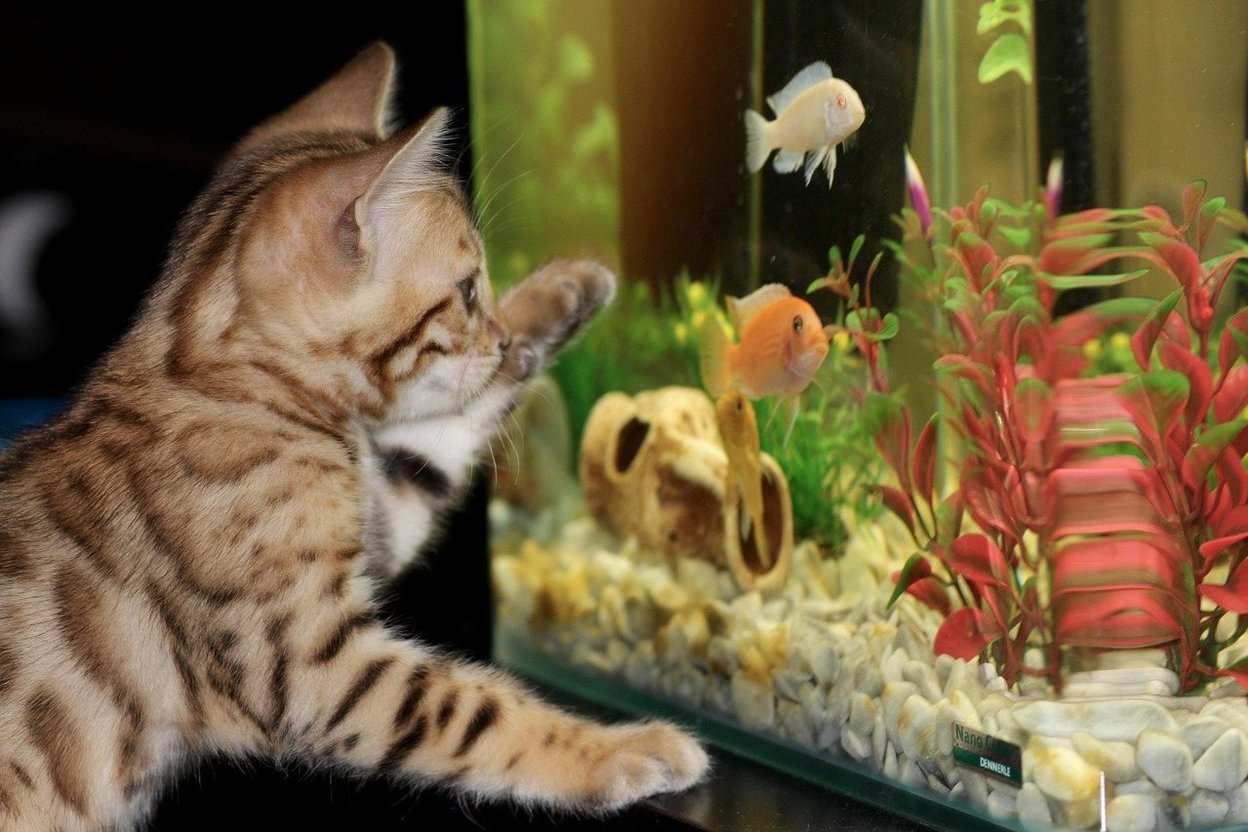
Photo by Irina_kukuts on Pixabay.
How many times an hour your filter should turn over your tank's water, with GPH math, river-tank targets, and why box ratings overstate flow.
Tank too cold in winter? Learn how to tell a too-small or misplaced heater from a drafty window, and fix it before the holidays.
Yes, a tank heater adds to your power bill, usually a few dollars to about $15 a month. Learn how to calculate your own heater's winter cost.