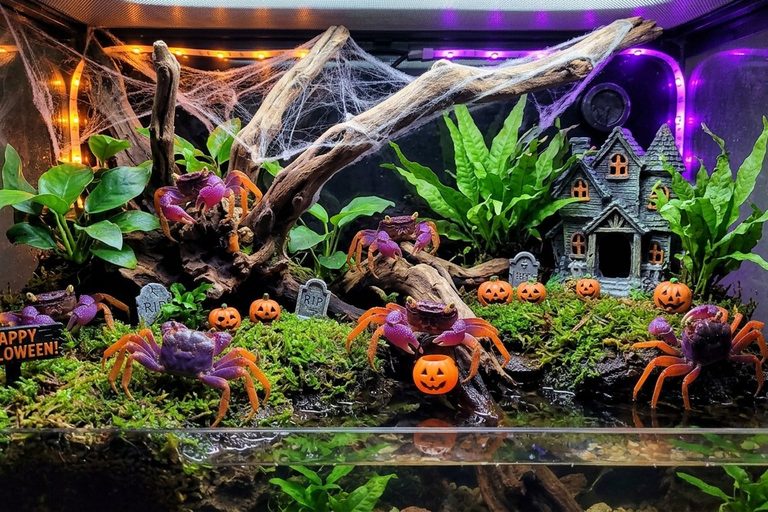
Can a crab get stuck in a pumpkin-house ornament?
Can a crab get trapped in a pumpkin-house ornament? See which openings are risky, how to pick or seal a safe piece, and how to free a stuck crab.

Find out which snails can live with a betta, what tank and water they need, and what can go wrong, from nipping to copper medication.
Jack·6 min read·May 20, 2021·Updated October 13, 2026
You're looking at your betta's tank, with algae creeping up the glass, and you wonder whether a snail would help or just become a snack. In most cases, yes, snails can live with bettas. The mystery snail is one of the most common betta tank mates and is usually safe. The answer still depends on your fish. Most bettas tolerate snails, some nip at them, and a very aggressive betta is better off alone. Below is how to choose a snail, set up the tank, and avoid the problems that catch owners out.
The snail matters less than the fish it's living with. A betta that ignores everything outside its own reflection will likely leave a snail alone. A betta that flares and charges at anything that moves may harass it.
The usual harm is nipping. A betta can damage a snail's tentacles or antennae, and some bettas roll snails over. Watch the two closely for the first days. If your betta injures the snail, move the snail to another tank. If your betta attacks any tank mate you add, accept that it's a solo fish.
One betta guide recommends a tank of at least 10 gallons once snails are added. That guide gives a betta range of 76–80°F (24–26°C) and a pH of 6.5–7.5.
Mystery snails need roughly 68–82°F, so a normal heated betta tank suits them. Their pH needs sit a little higher, at about 7.0–7.5, and some sources say up to 8.0. The overlap is around pH 7.0–7.5. Keeping the water steady in that range suits both animals better than chasing an exact number.
The mystery snail is the standard pick, and it's also a legal one to ship. In the trade, "mystery snail" usually means Pomacea diffusa. It's an apple snail, but federal rules treat it differently from its pest relatives (more on that below).
A few things to know before you buy one:
One compatibility guide rates bettas and nerite snails as a workable pairing that needs caution. As with mystery snails, the risk is an aggressive betta nipping the nerite's antennae. Plants, rocks and other hiding places give the snail somewhere to retreat.
Sources disagree about nerite breeding and water needs. Some hobby sources say nerites need brackish water to breed, and others go further. Read a dedicated nerite care guide before you buy one.
Some snails arrive by accident, as hitchhikers on plants, and multiply on their own. The Malaysian trumpet snail (Melanoides tuberculata, also called the red-rimmed melania) is a good example of how far a snail like this can spread. It's native to northern Africa and southern Asia. It has since established itself in the wild in the United States. The U.S. Geological Survey recorded it in Biscayne National Park in 2003. At one Biscayne Bay site, it reached densities of 60,000 per cubic meter between 2004 and 2007, more than any native snail there. It also carries a parasite that infects the endangered fountain darter.
In a tank, a fast-breeding snail raises the waste load and can crowd the substrate. Outside the tank, it can do real damage. Never release aquarium snails into a pond, stream or drain, even if you think you know the species. Hobbyists often misidentify snails.
Mystery snails belong to the apple snail family, Ampullariidae. Since a 2006 USDA APHIS rule, importing these snails or moving them between states requires a federal permit, with one exception. Pomacea diffusa, formerly called P. bridgesii, can move between states without a permit. It feeds mainly on algae and isn't known as an agricultural pest.
You may read online that moving any apple snail across state lines is illegal. That doesn't match the APHIS exemption for the common mystery snail.
States can set their own rules:
These lists come from older documents, so check your state wildlife agency's current rules if you live in one of these states.
This is where many snails die. Copper is the main danger, because copper sulfate is widely treated as deadly to aquatic invertebrates. One retailer listing for Seachem Cupramine, a copper treatment, says it kills snails. The same listing says it isn't recommended for betta fungus or fin rot anyway.
A Singapore aquarium retailer also lists formalin, malachite green and methylene blue as treatments that kill invertebrates. That's a retailer's warning, not an official finding, but caution is still wise. When your betta needs treatment, move the snail to another container first, or treat the betta in a separate hospital tank.
If your betta is calm, your tank is about 10 gallons or more, and you can hold the water near 76–80°F and pH 7.0–7.5, a single mystery snail is a sensible first tank mate. Watch them closely at first and give the snail places to hide. Move the snail out before any copper treatment, and remove it quickly if it dies. If your betta keeps nipping, rehome the snail. Some bettas are happier alone.
Can a crab get trapped in a pumpkin-house ornament? See which openings are risky, how to pick or seal a safe piece, and how to free a stuck crab.
Vampire crabs make tempting Halloween impulse buys at $10, but they need a land-heavy paludarium to survive—not a traditional fish tank.
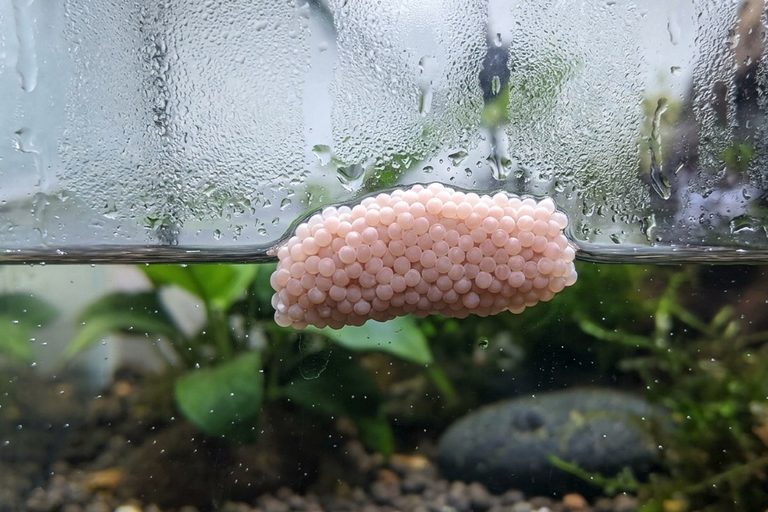
Tell snail eggs apart by species (nerite dots, mystery snail clutches, ramshorn and bladder jelly) and decide whether to scrape, keep, or hatch them.