Hellbender Eggs at the Tennessee Aquarium: What's Planned, and How Zoos Hatch America's Giant Salamander
A 2026 plan would raise South Toe River hellbender eggs at the Tennessee Aquarium. Here's how hellbenders hatch, grow and return to the river.
Five newly named Southern hickorynut mussels, why they're hard to keep, and why most states won't let you put one in your native tank.
Jack·11 min read·November 26, 2026
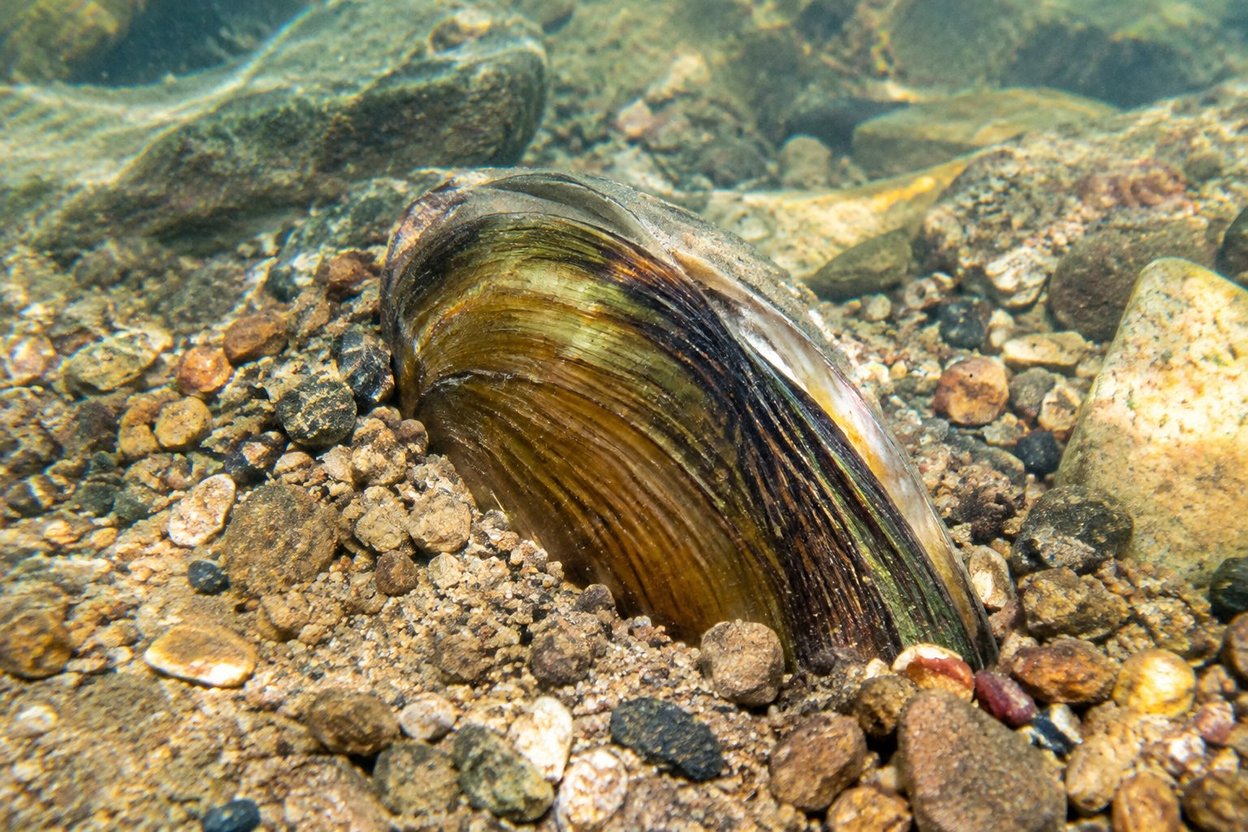
Maybe you've waded a creek on a cool fall afternoon, when the water is low and clear, and spotted a mussel half-buried in the gravel. Your first thought might have been how good it would look in your native tank. That idea is going around again now that scientists have named five new freshwater mussel species from Alabama, Mississippi, Louisiana, Texas, Arkansas and Missouri. Here's the short answer. These are newly recognized wild species, often rare and found in only a few rivers. No one has published a home-aquarium method for them, and in many states taking or keeping native mussels is illegal without a permit.
All five belong to the genus Obovaria, the hickorynuts. They didn't turn up in some unexplored corner of the map. They had been living in Southern rivers the whole time, mixed in with look-alike species. Researchers call these "cryptic species": animals that look so much alike that only careful study shows they are separate.
The paper came out in Zootaxa on September 23, 2026 (volume 5881, issue 4, pages 451–488). The authors are Kentaro Inoue of Shedd Aquarium, John L. Harris of Arkansas State University and Nathan A. Johnson of the U.S. Geological Survey. Shedd announced it on October 1. Shedd says the work grew out of about 20 years of fieldwork: people in masks and snorkels feeling through streambeds and taking genetic samples for the lab.
They didn't separate the species on looks alone. They combined four kinds of evidence: shell shape, side-by-side comparison of shells, where each population lives, and DNA. When all four lines agree that a group is distinct, it gets its own name.
At least one popular write-up of this discovery names only four of the five. Here is the full list:
The same revision also moved one species out of the genus. Its DNA showed it was distinct enough from Obovaria to get a genus of its own, so it is now Pseudoon olivarium.
This sounds like paperwork, but it changes how these animals get protected. A species that looks widespread can turn out to be several species, each living in a single river system. The authors say several of the newly recognized hickorynuts are rare and limited to small areas, so they argue for conservation planned river basin by river basin. If the Big Thicket Hickorynut only lives in a few drainages in Louisiana and Texas, protecting it means protecting those waters specifically.
North American mussels were already in trouble. A U.S. Fish & Wildlife Service brochure cites an estimate from Williams and colleagues in 1993: about 70% of U.S. freshwater mussels are extinct, endangered or in need of special protection. You'll see that figure quoted as "70% are endangered today." That's not what it says. It's a 1993 estimate, and it lumps extinct species and species needing special protection in with listed ones.
The North American list keeps growing. The Freshwater Mollusk Conservation Society's checklist for the U.S. and Canada, dated August 3, 2025, counts 298 species in the family Unionidae and five in Margaritiferidae. Other recent discoveries are separate from these five but show the same pattern. North Carolina described the Uwharries Elktoe in 2023. In October 2025 the state reported that another newly described mussel, the solstice creekmussel (Ligodonta obscura), survives in a single four-mile stretch of one stream.
One correction to a claim that's going around: identifying a mussel doesn't always mean killing it. For the Uwharries Elktoe, Fish & Wildlife researchers collected DNA with nonlethal cheek-style (buccal) swabs. They also kept five whole animals as museum voucher specimens, which is a separate, deliberate scientific step.
This is the part that matters for anyone with a native tank. A mussel isn't a decoration that happens to be alive. It lives on what it can strain out of the water.
Georgia DNR describes native mussels as filter feeders that eat suspended algae, plankton, detritus and bacteria. USGS adds that mussels get both their oxygen and their food by filtering water while sitting buried in the streambed. That's also why they're so sensitive to polluted water and sediment. A creek brings them a steady supply of food. A tank brings them whatever you put in.
Professionals treat feeding as a research problem, not something you do with a pinch of flakes. A Texas mussel project's 2012 report describes feeding captive mussels a mix of algae grown in aquariums and commercial microalgae products. By the 2014 final report, the team was growing five separate algae strains alongside commercial algae concentrates. That's a funded team with dedicated systems, and they were still working it out.
Hobbyists who have tried report the same thing. On a Monster Fish Keepers thread about mussels in aquariums, a North Carolina member with 55 years of fishkeeping said he had never had success indoors, though he did better outdoors. That's one person's experience, not a controlled study, but it fits everything above. An Illinois member suggested running a separate, window-lit algae tank to feed a mussel tank. It's an interesting idea, but nobody showed it working. Aquariadise, which is more upbeat about clams in aquariums, still warns that they starve and that dead ones can go unnoticed in the substrate. That last warning is the one I'd worry about. A mussel that dies out of sight decomposes in your water while your fish breathe it.
Keeping an adult alive and getting mussels to reproduce are two separate problems, and the second is harder. Fish & Wildlife explains that mussel larvae, called glochidia, clip onto a host fish for several weeks before dropping off as juvenile mussels. Some mussel species can only use a few kinds of fish as hosts.
Host lists are specific to each species. Missouri's profile for the pondmussel names green sunfish, orangespotted sunfish, warmouth, bluegill and largemouth bass among its hosts. Florida FWC raises Ochlockonee Moccasinshell larvae on blackbanded darters at national fish hatcheries. Those are other mussels. Don't assume the five new hickorynuts use the same fish. Their hosts aren't part of the naming work.
Specialists also have options a home keeper doesn't. Ohio's January 2026 conservation sheet describes the Watters Aquatic Conservation Center using both host-fish infection and lab propagation without fish (in vitro). That is serious conservation infrastructure.
It depends on where you live, and the rules are often stricter than people expect. Three examples show the range. They're examples, not a nationwide answer:
Also keep two ideas apart. A newly named species is not automatically federally listed. The naming paper doesn't make any of the five hickorynuts endangered under the Endangered Species Act, and it doesn't make them legal to sell either. Rarity, state protection and federal listing are separate questions. Check your state wildlife agency before you pick anything up.
When native mussels are off the table, people often reach for whatever "freshwater clam" they can find. Ask what it actually is. Corbicula, the Asiatic clam, is invasive in the U.S. Alabama Extension warns that dense populations can strip enough phytoplankton out of a pond to reduce its productivity and slow fish growth, and it advises against introducing them. A clam that gets into a pond or creek from a dumped tank isn't harmless.
Known: - The five common and scientific names, and the basins and states where each lives. - That they were separated using shells, geography and DNA together. - That several are rare and found in only a few areas. - That mussels in general depend on suspended food, clean water and sediment, and host fish for their larvae.
Not established: - Safe home-aquarium temperature, pH, tank size or diet for any of the five. - Which fish species host their larvae. - Whether any are, or ever will be, legally available as aquarium animals. - Any new federal listing status.
You can still get close to these animals without taking one from a river.
Go see them at a public aquarium. In April 2025 the Tennessee Aquarium opened a mussel exhibit with Purple Wartyback, Threehorn Wartyback and Painted Creekshell from Tennessee's Duck River. A trip over Thanksgiving break is an easy way to show kids what's living in Southern riverbeds.
Support the people who raise them. Kansas City Zoo & Aquarium's propagation partnership has run since 2007, and by January 1, 2024 it had returned tens of thousands of mussels to rivers in four states. That's what captive mussel keeping looks like when it works: specialists raising them to put back.
Care about fish passage too. In 2024, Virginia removed the Ashland Mill Dam on the South Anna River, which reopened the river to migrating fish. In June 2026, more than 750 alewife floaters were planted there. Mussels need their host fish to move freely, so a dam removal can be mussel habitat work.

I love the native-tank idea, and the river-tank idea in general. My River Tank EcoSystem in a 55-gallon long pumped water up on the left, carried it across and cascaded it down through three pools. Making a tank feel like a slice of a real stream is the whole fun of this hobby. But a real stream has things a glass box doesn't: endless suspended food, constant fresh water, and the fish that carry mussel larvae.
So build your native tank around animals you can legally and humanely keep, and leave the hickorynuts in the Tombigbee, the White, the Pearl and the Big Thicket drainages. If you find one while wading this fall, look, take a photo, and set it back where it was.
Are these five aquarium species? No. They are newly recognized wild species, several of them rare. There's no tested home-care method, and nothing suggests they're legal to sell.
Can I collect one? In many places, no. South Carolina requires a scientific permit for nearly any handling, and Maryland bans keeping mussels caught in its waters, with narrow exceptions. Check your state agency first.
Can I keep an empty shell? Not always. Indiana protects shells too and requires a license or permit to possess them.
Does a mussel need fish? For reproduction, yes. The larvae have to attach to a suitable host fish for several weeks. The hosts for these five aren't established, so don't borrow host lists from other mussels.
Is an Asian clam the same thing? No. Corbicula is an invasive Asiatic clam, and dense populations can harm ponds and fish growth. Don't add one to a tank or release one outdoors.
A 2026 plan would raise South Toe River hellbender eggs at the Tennessee Aquarium. Here's how hellbenders hatch, grow and return to the river.
Orange Pumpkin, Sunkist and Orange Rili are all Neocaridina davidi. Here's which fish can share a river tank with them and which will eat them.
Can a crab get trapped in a pumpkin-house ornament? See which openings are risky, how to pick or seal a safe piece, and how to free a stuck crab.