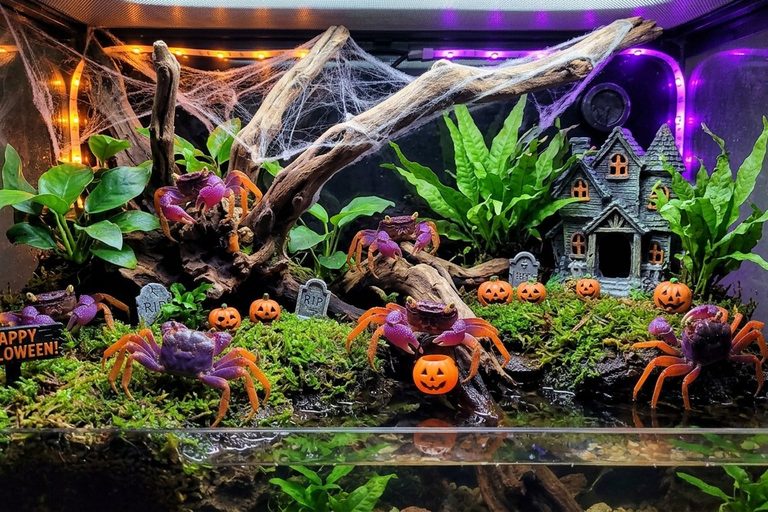
Can a crab get stuck in a pumpkin-house ornament?
Can a crab get trapped in a pumpkin-house ornament? See which openings are risky, how to pick or seal a safe piece, and how to free a stuck crab.
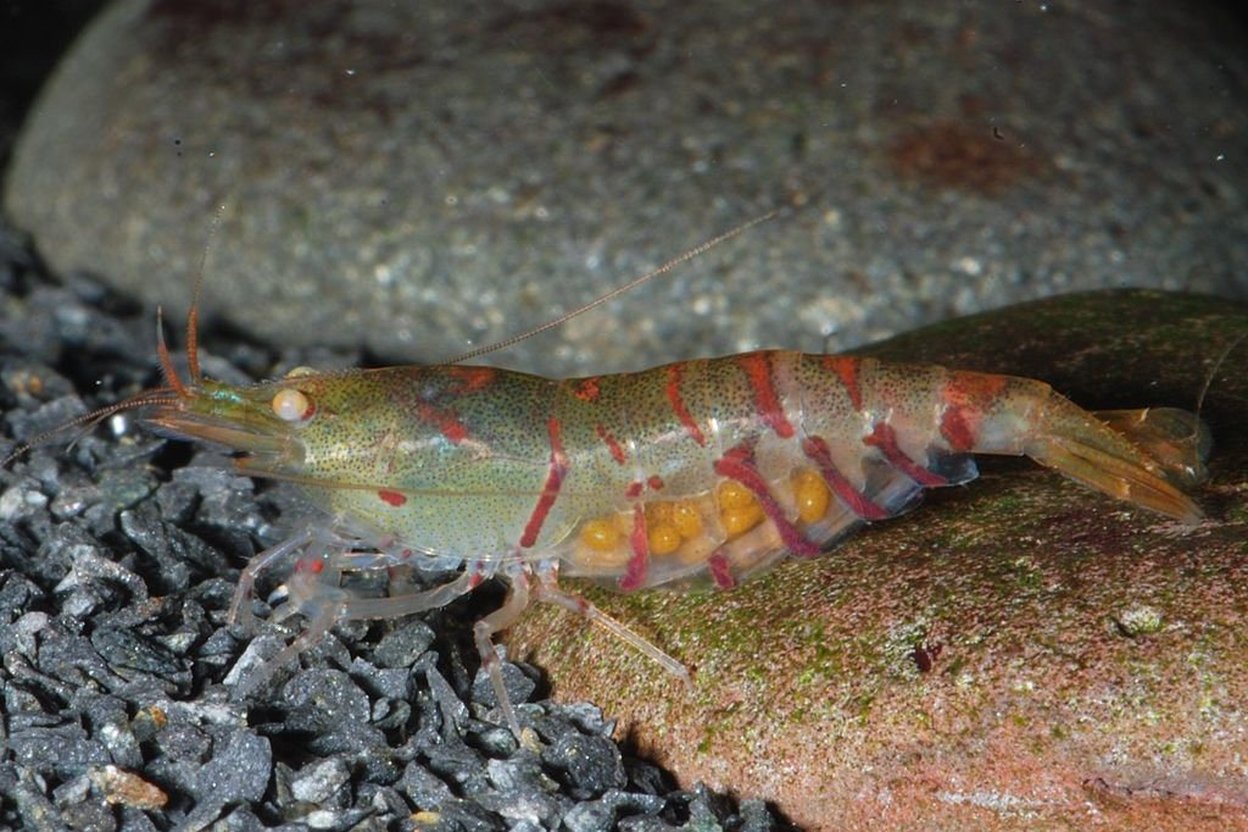
Orange Pumpkin, Sunkist and Orange Rili are all Neocaridina davidi. Here's which fish can share a river tank with them and which will eat them.
Jack·7 min read·October 23, 2026
You're standing at the store's shrimp rack looking at Orange Pumpkin, Sunkist and Orange Rili, and you're thinking about your stream tank at home and the fish already swimming in it. Here's the short answer. Every one of those shrimp is the same animal, Neocaridina davidi, and they all need the same care. The shrimp you pick barely matters. What matters is which fish you already have. Small, peaceful fish can work. Mid-size or hungry fish will eat your shrimp.
Orange Pumpkin, also sold as Orange Sakura, is an orange color form of Neocaridina davidi. That's the cherry shrimp species, and it originally comes from Taiwan. Orange neon, Sunkist orange and Orange Rili are color variants of the same species, and their care is "the same as cherry shrimp."
That makes buying simple. You're choosing a look and a price. You're not choosing a different animal with different needs. A Sunkist and an Orange Sakura want the same water, eat the same food and get eaten by the same fish.
The fish are the part that takes some thought. Most fish sold as "shrimp-safe" leave adult shrimp alone but eat the babies. So "safe" has two meanings. One is that your shrimp survive. The other is that your shrimp colony grows. A tank where the adults live out their lives but no young ever grow up is a slow fade, not a colony.
A river tank makes this harder because of the kind of tank it is. My old setup was a 55-gallon long with the River Tank EcoSystem's X-Large kit: water pumped up on the left, carried across, and cascading down through three pools. That design is built around a mixed community. Before you add shrimp to one, look honestly at what already lives there.
Within each type, shrimp are sold by color grade. Deeper, more solid color costs more. Females are brighter and less see-through than males, so a group always looks a little patchy.
Keep one color per tank. Mixed Neocaridina colors tend to produce weak orange or clear "wild type" young. Even in a single-color tank, keepers who care about color move the pale shrimp out so they don't pass that on.
Adults reach about 3 cm (1.2 in) and live about 1 to 2 years if the water stays steady. That's small enough to fit in a lot of mouths, which brings us back to the fish.
The sources don't all agree, so here they are sorted by how much risk each fish brings.
Safest - Otocinclus. Practical Fishkeeping calls them "100% safe," and Aquarium Co-Op lists them as compatible. - Dwarf rasboras (Boraras), such as the chili rasbora. Both sources rate them well. - Thin suckermouth catfish such as Farlowella, which Practical Fishkeeping puts in its lowest-risk group. - Ember tetras, green neon tetras and pygmy corydoras, which Aquarium Co-Op lists as generally compatible.
Gambles (the adults probably survive, the babies probably don't) - Guppies and Endlers. Aquarium Co-Op calls them compatible, while Practical Fishkeeping says guppies will almost certainly eat the young. The sources only disagree about babies, not adults. - Small danios, kuhli loaches, pencilfish, clown killifish, corydoras and White Cloud Mountain minnows. Practical Fishkeeping says all of these "will almost certainly eat the young." - Bettas. Practical Fishkeeping calls them a gamble, Modest Fish calls them "hit or miss," Shrimp Science calls it trial and error, and Aquarium Co-Op lists them as unsafe. Each betta acts differently.
Avoid - Cichlids, even the dwarf ones - Goldfish - Rainbowfish (Practical Fishkeeping specifically names the large ones) - Large gouramis, plus dwarf gouramis on Aquarium Co-Op's list - Puffers: Aquarium Co-Op lists pea puffers as unsafe, and Practical Fishkeeping calls dwarf puffers a gamble at best - Zebra danios and silver tip tetras (Aquarium Co-Op) - Spiny eels, larger livebearers, most loaches, and larger tetras and barbs
Modest Fish gives a simple rule: skip any fish over 3 inches (7.5 cm) and anything aggressive. If your river tank already holds fish on the avoid list, orange shrimp will just be expensive fish food.
All the published numbers come from hobby sites and sellers, and they vary:
Where the sources overlap you get a safe middle: pH around 7.0 to 7.6, GH 4 to 8, and roughly 68 to 76 °F. That's moderately hard, neutral-to-slightly-alkaline water, which a lot of community fish are also fine in. Shrimp breed much faster near 75 °F (24 °C). With fall here and houses cooling off at night, check that your heater actually holds the tank steady. Stable water matters more than hitting an exact number. Don't chase pH with pH up/down products.
The pump is the real danger in a flowing tank. A sponge filter is the top pick for shrimp because it makes very little flow. A river tank needs a pump to move water, though. Whatever pulls water in, whether a powerhead, hang-on-back or canister, put a sponge pre-filter over the intake so shrimp and babies don't get sucked in. My own view, not a sourced fact: the calmer pools and the edges behind stones are where shrimp will spend most of their time, so put the cover there.
Cover. Fish cut down on how many baby shrimp survive, and thick cover is how you push back. Aquarium Co-Op recommends rock piles, shrimp caves, and dense Java moss, Pogostemon stellatus 'Octopus' or water sprite. A stream tank already has smooth stones and driftwood, so tuck moss into the gaps.
Shrimp first, if you can. Practical Fishkeeping says to add fish only after the shrimp colony is established, and Shrimp Science says to keep fish out while the colony grows. In a river tank that's already running, you can't do that. Add a good-sized group and expect slow growth, not a boom.
Medications and copper. Practical Fishkeeping warns that fish medications are often unsafe for invertebrates. One shrimp-keeper guide puts the lethal copper level for Neocaridina at about 0.03 to 0.05 ppm, while many fish treatments are dosed at 0.25 to 0.50 ppm. That's a hobby figure, but the gap is big enough that it doesn't matter much if it's a little off. If a fish needs treatment, do it in a quarantine tank, or take every shrimp out first.
The first month. Test the tank and match its numbers to the ranges above before buying. Then test weekly for ammonia, nitrite, nitrate, GH and KH, plus TDS if you have a meter. Do small, regular water changes. Large, frequent ones can cause molting deaths. And keep a full screen lid on. The crabs in my old tank taught me early that animals get out of almost anything.
Photo: Caridina-cf-cantonensis-orange-eye-tiger by DirkBlankenhaus, CC BY-SA 3.0.
Can a crab get trapped in a pumpkin-house ornament? See which openings are risky, how to pick or seal a safe piece, and how to free a stuck crab.
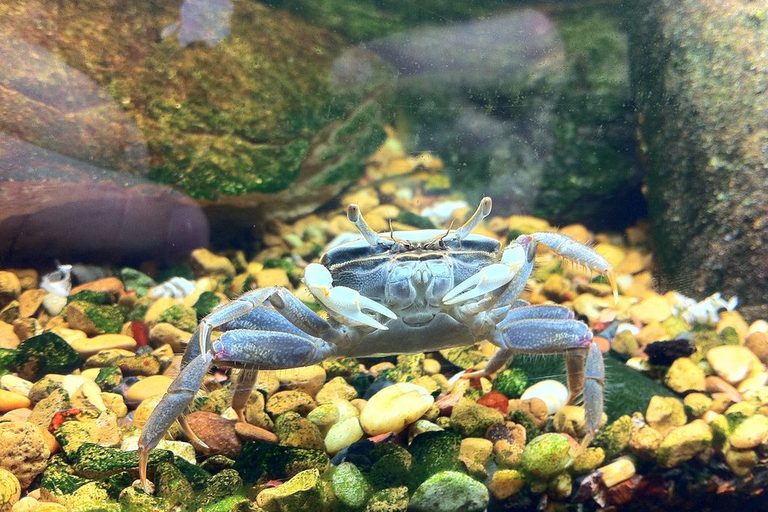
Vampire crabs make tempting Halloween impulse buys at $10, but they need a land-heavy paludarium to survive—not a traditional fish tank.
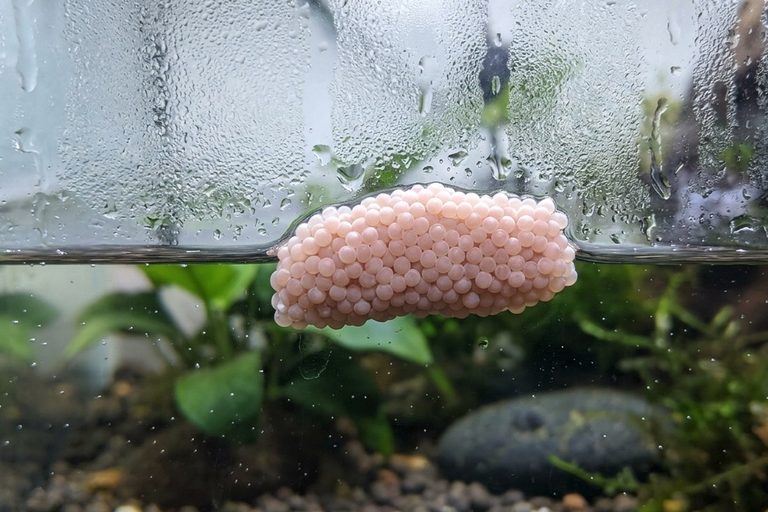
Tell snail eggs apart by species (nerite dots, mystery snail clutches, ramshorn and bladder jelly) and decide whether to scrape, keep, or hatch them.