How to Dechlorinate Tap Water for an Aquarium (and Why Chloramine Changes the Rules)
Learn how to dechlorinate tap water for your aquarium, check whether your city uses chloramine, and dose conditioner correctly for water changes.
Will party music stress your fish? Here's what the research shows, what actually causes party-day losses, and a five-minute checklist to prevent them.
Jack·7 min read·November 1, 2026
You're counting chairs for Thanksgiving, or setting up a speaker for a Halloween party, and you look over at the tank. The fish will be about six feet from twenty guests and a playlist for the whole evening. Will the noise hurt them? Loud, sudden or long-lasting noise probably does stress fish some, but a few hours of music is unlikely to harm healthy fish. On party day, the bigger dangers are tapping fingers, unplugged equipment and extra food.
Fish don't hear your party the way you do. They sense vibration and pressure moving through the water, not the voices and music in the air. Your tank is still not soundproof. Glass carries vibration well, so heavy bass and hard impacts reach the water.
Studies do show that noise can stress fish. Those studies looked at a few particular species in hatchery or lab tanks. None of them tested a typical community tank in a living room. Applying them to your Saturday night is my own inference, not something anyone has measured directly.
Here's how I'd weigh it. One evening of music and conversation is unlikely to do lasting harm to healthy fish in a stable, cycled tank. Party-day losses usually come from other causes:
You can prevent all three.
The best-known study is from Miami. In 2019, researchers put Gulf toadfish in hatchery tanks near the Ultra Music Festival, a three-day event in March that drew about 50,000 people. Airborne sound at the hatchery stayed below about 72 dBA. On the festival's first night, the fish's blood cortisol (the main fish stress hormone) rose 4 to 5 times. That was higher than the response to a simulated predator chase and similar to the response to bottlenose dolphin sounds, which come from a real toadfish predator. The authors called the results preliminary and couldn't say whether the festival caused any long-term harm.
An earlier study used a quieter but steadier source of noise. Thirty-two lined seahorses were housed one per tank for a month, in either loud or quiet tanks. The noise came from circulation pumps. The seahorses in loud tanks lost more weight and body condition and showed signs of a suppressed immune system. They were most restless in the first week and then got used to the noise. The authors called noise "a chronic, subtle stressor." This was a 2007 conference paper, not a peer-reviewed journal article.
A zebrafish study points the other way. Random tapping on the side of the tank, hard enough to startle the fish, did not significantly change their cortisol. Only food deprivation did.
So the results are mixed. A huge outdoor event stressed one species. Constant pump noise wore on seahorses over weeks. Tapping startled zebrafish without raising their stress hormone. None of these was a home aquarium at a party.
One detail from the toadfish study matters for anyone with a glass box of water in the house. During the festival, underwater low-frequency sound rose only 2 to 3 dB in the open channel nearby but 7 to 9 dB inside the hatchery tanks. The tanks picked up more of the noise than open water did.
The same thing happens at home, mostly with low frequencies. Bass is the part of the music that shakes things, and a tank resting on the same shelf as a speaker, or against a wall with a subwoofer, gets that vibration straight through its base and glass. Talking and laughter in the air are much less of a concern.
Sudden impacts are a different problem. A knock on the glass, a slammed cabinet or a dropped dish sends a sharp jolt into the water. Most fish respond with a startle: a dash, a dive for cover, sometimes a bump into the décor. One startle passes quickly, but a whole evening of them is not good for the fish.
Most of this takes five minutes the morning of the party:
The next morning, watch the tank for a few minutes before you start cleaning up. Signs of a rough night include:
If the behavior has clearly changed, test ammonia and nitrite right away. Gasping in particular can point to a water problem rather than noise, and extra food is the usual cause. If the readings are fine, noise stress usually fades once the house is quiet again. Keep up your normal water changes and filter maintenance through the holidays.
River-tank setups need a little extra thought. Shy bottom fish and fish that live in fast current hold position behind stones and roots, and they're the ones that will look for cover when the room gets loud. Before the party, make sure every one of them has a place to tuck into, out of the flow and out of view.
Plan for one evening, not for a lifetime of noise. The research gives good reasons to keep tanks away from constant pump hum and pounding bass. A night of Halloween music or a loud Thanksgiving table is a much smaller problem. Prevention costs almost nothing: move a speaker, tape down a power strip, check the heater, ask guests not to tap the glass, and feed only the usual amount. Do that, and the fish will probably have a quieter night than you will.
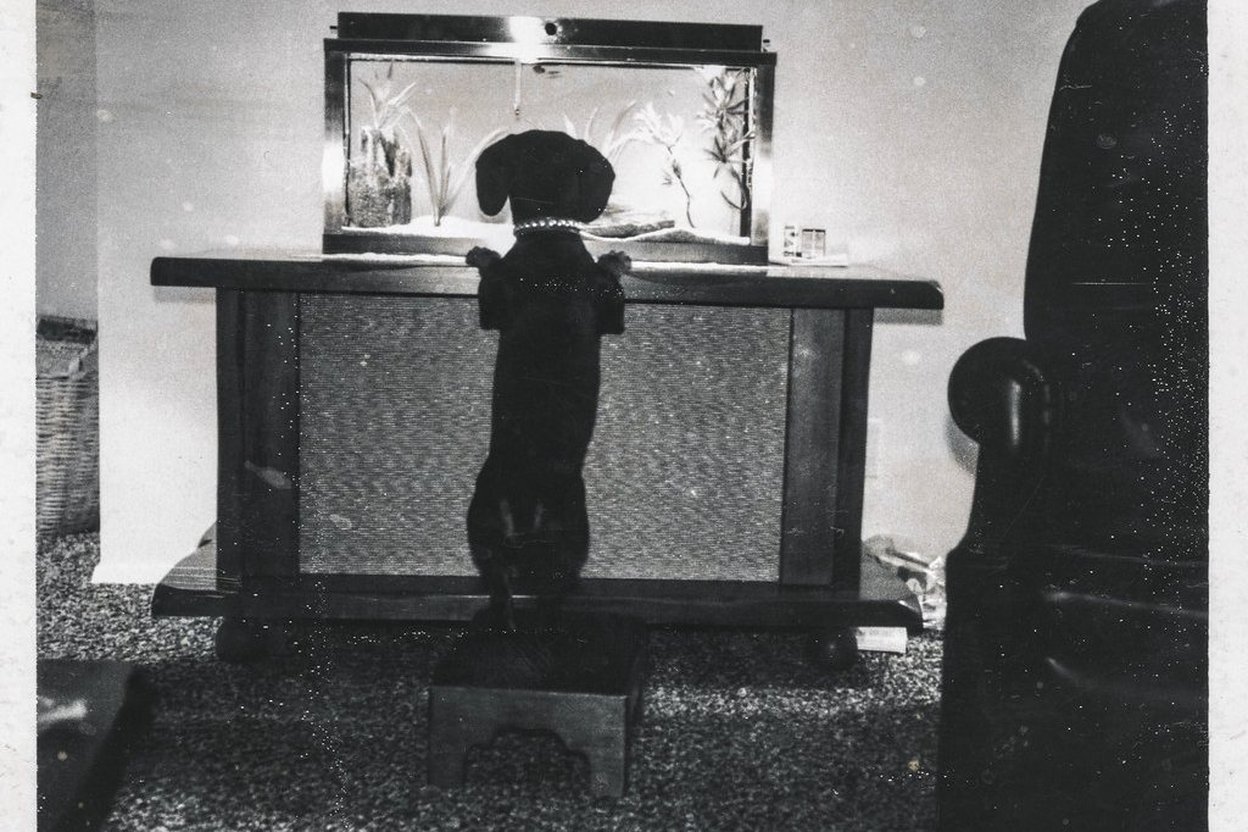
Photo: Dog peers into a fish tank by simpleinsomnia, BY 2.0.
Learn how to dechlorinate tap water for your aquarium, check whether your city uses chloramine, and dose conditioner correctly for water changes.
Brown diatom film on a new tank's glass and stones is normal. Learn what causes it, how to wipe it off, and the fixes if it won't fade.
How many times an hour your filter should turn over your tank's water, with GPH math, river-tank targets, and why box ratings overstate flow.