Are store-bought Halloween ornaments safe underwater?
Learn which Halloween ornaments are safe in a fish tank, why craft-store decor is risky, and a simple screening test before adding one.
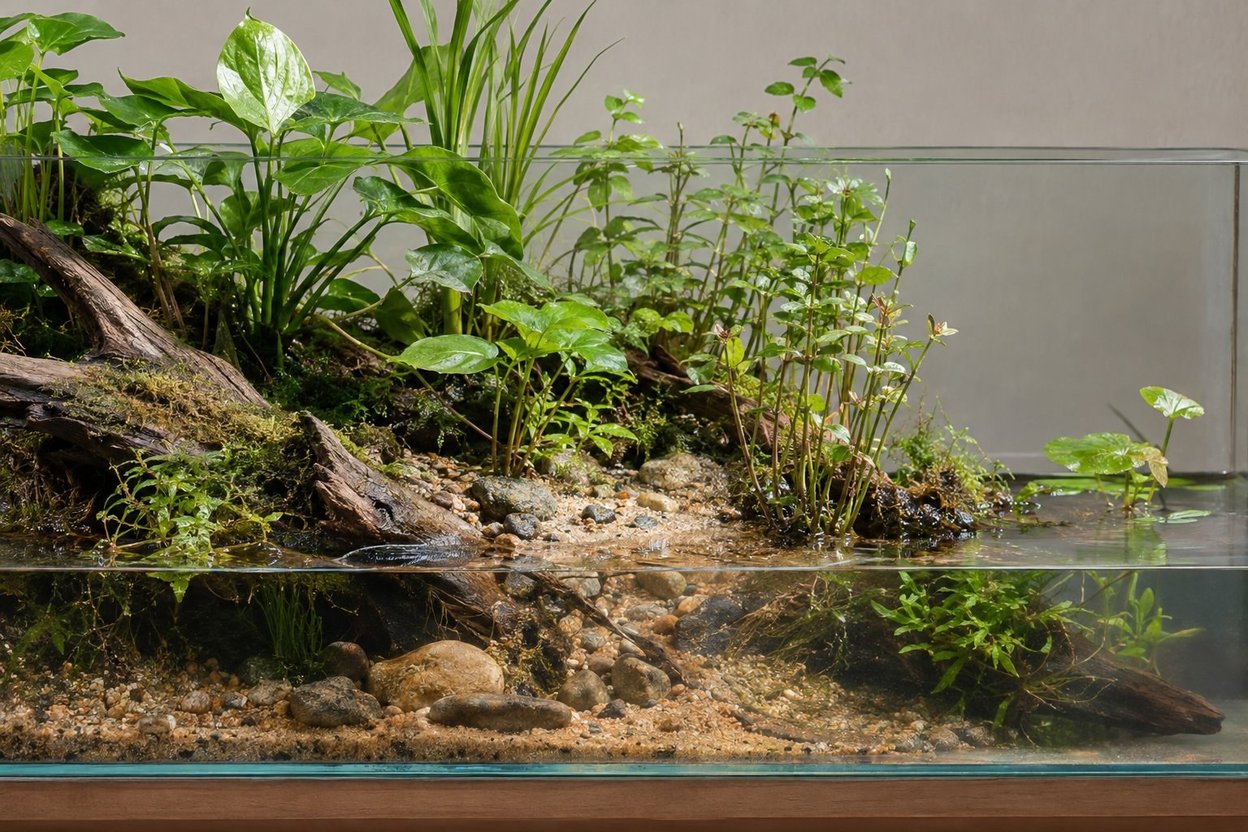
Learn what a riparium is and what you need to build one: an open-top tank, planters, plants that tolerate wet roots, and light above the water.
Jack·8 min read·October 18, 2026
You've probably cut a pothos vine from a houseplant, dropped it in a jar of water, and watched white roots grow out of it within a couple of weeks. A riparium works the same way, set inside an aquarium. The plants sit in small planters at the water's surface. Their roots hang down into the tank water and their leaves grow up into the open air. The short shopping list is an open-top tank, some planters, the right plants and a second light above the water. Everything else is detail, and the details are below.
A riparium is a tank that is mostly water, with plants growing emersed. That means their roots are in the aquarium water and their leaves are in the air. The plants are held in planters that clip onto the rim or stick to the back glass. One common way to describe it is a vivarium style built from hanging planters clipped inside a standard aquarium. From the front you see a planted shoreline, like the overhanging bank of a creek, and a full aquarium below it.
That's why it caught my eye. For years I ran a River Tank EcoSystem by Finn Strong Designs, the X-Large kit, in a 55-gallon long. Water was pumped up on the left, carried across, and cascaded down through three pools. The riparium is the same idea of a real stream, but the plants live along the bank and the water stays the main event.
Here is what you actually need:
You don't need CO2 injection. Emersed plants get their CO2 from the air, and a longtime riparium keeper on the Monster Fish Keepers forum says that water-column or root-tab fertilizer is usually enough. You can also usually convert a tank you already own by adding planters and plants.
These words get used loosely, and you'll see the same tank called either one. Here's how I use them. A riparium is about 80–95% water, with only small planters breaking the surface. A paludarium has real land, with one guide putting the water at roughly 30–50%.
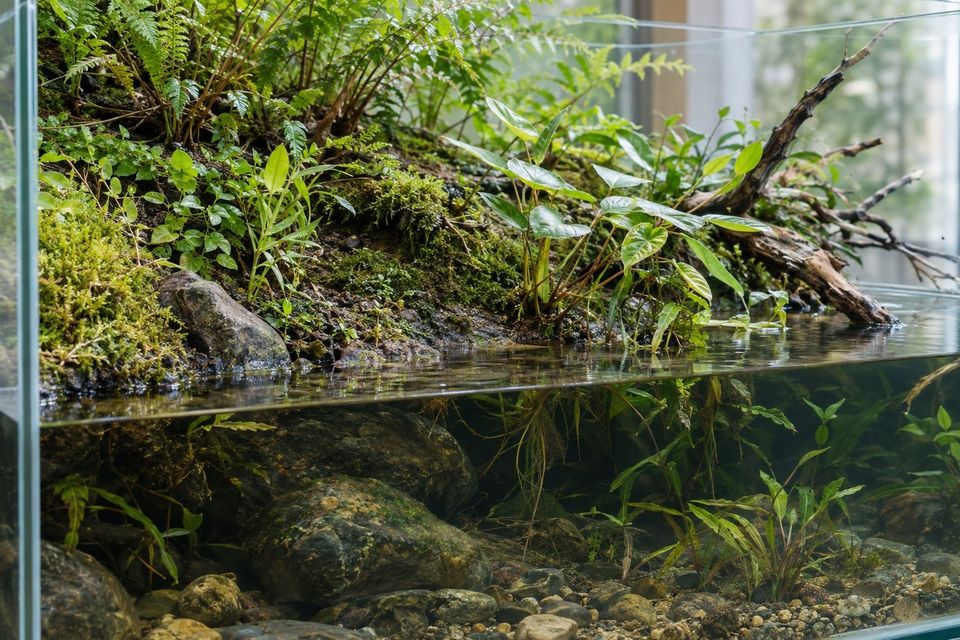
The difference matters most for animals. A riparium has very little land, so it usually can't support animals that depend on land. The fire-bellied frogs and little crabs that did well in my river tank would be the wrong fit here. Climbing animals flatten the thin, soft stems of riparium plants, and there's nowhere real to bask. For frogs, crabs or anything amphibious, build a paludarium or a hybrid with sturdy plants.
There's also a practical reason. I learned quickly that crabs and some reptiles get out of almost anything, so I swapped my light kit for a full screen lid. A riparium has to stay open on top, which means escape artists are ruled out from the start.
There are two basic commercial types:
Either way, it's a basket or cup that holds the growing medium, and the roots grow out through the base into the water. If you'd rather build your own, you can use mesh baskets lined with foam or sphagnum, PVC pipe sealed at one end, or clip-on pots with drainage holes.
Fill the planters with an inert medium: clay pebbles (LECA), coarse gravel, sphagnum moss or coconut coir. Some keepers use aquasoil, but it isn't inert, so expect it to add nutrients to the water. Leave out regular potting soil. It clouds the water and fouls the tank.
For height, one guide suggests setting the planter base 1–2 cm (about half an inch to three-quarters of an inch) below the waterline. That keeps the roots wet between top-offs while the medium near the top stays fairly dry. When the water level drops, the planters are the first thing to dry out, so remember that number.
For layout, stagger the planters at different heights and put the taller plants in the corners so the bank looks natural instead of like a row of pots. A rimless tank makes this easier, because there's no frame in the way of clips or light. One retailer suggests an open-top rimless tank 60–90 cm long (about 24–36 inches), with 25–35 cm (10–14 inches) of water and at least 25–30 cm (10–12 inches) of open space above it. Those are one shop's suggestions, not rules, but they give you a reasonable starting point.
This is where most first ripariums succeed or fail. Wet roots are short on oxygen, and that kills most plants. One experienced keeper says it bluntly: not just any plant is fine in a riparium.
Easy starters among houseplants:
Aquarium plants that grow well emersed:
Many aquarium stem plants are grown emersed on nursery farms in the first place, so they often look better above the water than below it.
How to plant them: rinse every bit of potting soil off the roots before anything goes in the tank. Only the roots should sit in the water. For pothos, keep the leaves and stem nodes above the surface. Keep the crown of a peace lily dry too, because a submerged crown can rot within a couple of months.
What to skip: succulents, cacti and epiphytic orchids will probably lose their roots in constant water.
One caution: peace lilies contain calcium oxalate crystals. These may harm fish that eat a lot of the plant. That claim comes from limited sources, but if you keep fish that chew on plants, start with Syngonium or emersed Hygrophila instead.
Once the plants are in, light is the next problem. Your aquarium light is built to shine down into the water, so it barely reaches the leaves growing above it. Add a second LED panel or a grow light over the opening. One retailer suggests an adjustable LED hung 30–40 cm (12–16 inches) above the water, run for 8–10 hours a day. A bright window can add some light, but keep the tank out of direct sun. As the days get shorter heading toward Thanksgiving, I'd rely on the lamp and treat window light as a bonus.
Water loss is the cost of an open top. Sources disagree on how often to top off: one says daily, another says weekly. The honest answer is to check your level every day or two and refill before the planter bases are out of the water. Humidity figures you see online, often 75–90%, tend to come from tropical Singapore shops. Many US homes are drier, especially once the heat comes on, so expect faster evaporation and possibly some crisp leaf edges.
Routine care:
About nitrate: many keepers report that pothos roots lower their nitrate readings, and some likely benefit is real. But the evidence is anecdotal, and some keepers think the bacteria living on the roots do more than the plant does. Treat it as a bonus, not a replacement for water changes.
The water below the roots is a calm, shaded pool, so pick small, peaceful fish. Riparium guides suggest:
Check the needs of each species before you mix them, and get your tank cycled before any of them go in. Then you'll have a stream bank in your living room.
Learn which Halloween ornaments are safe in a fish tank, why craft-store decor is risky, and a simple screening test before adding one.
Discover why whole pumpkins damage aquarium water and how to safely offer small pieces as seasonal treats.
Which leaves are safe in a fish tank, how many to use, how to collect and prep oak leaves, and which trees to skip.