Should You Turn Down the Heater in a Fish Tank When You Go on Vacation
Usually, leave the heater alone. Learn why, which risks matter most while you're away, and a simple plan by trip length.
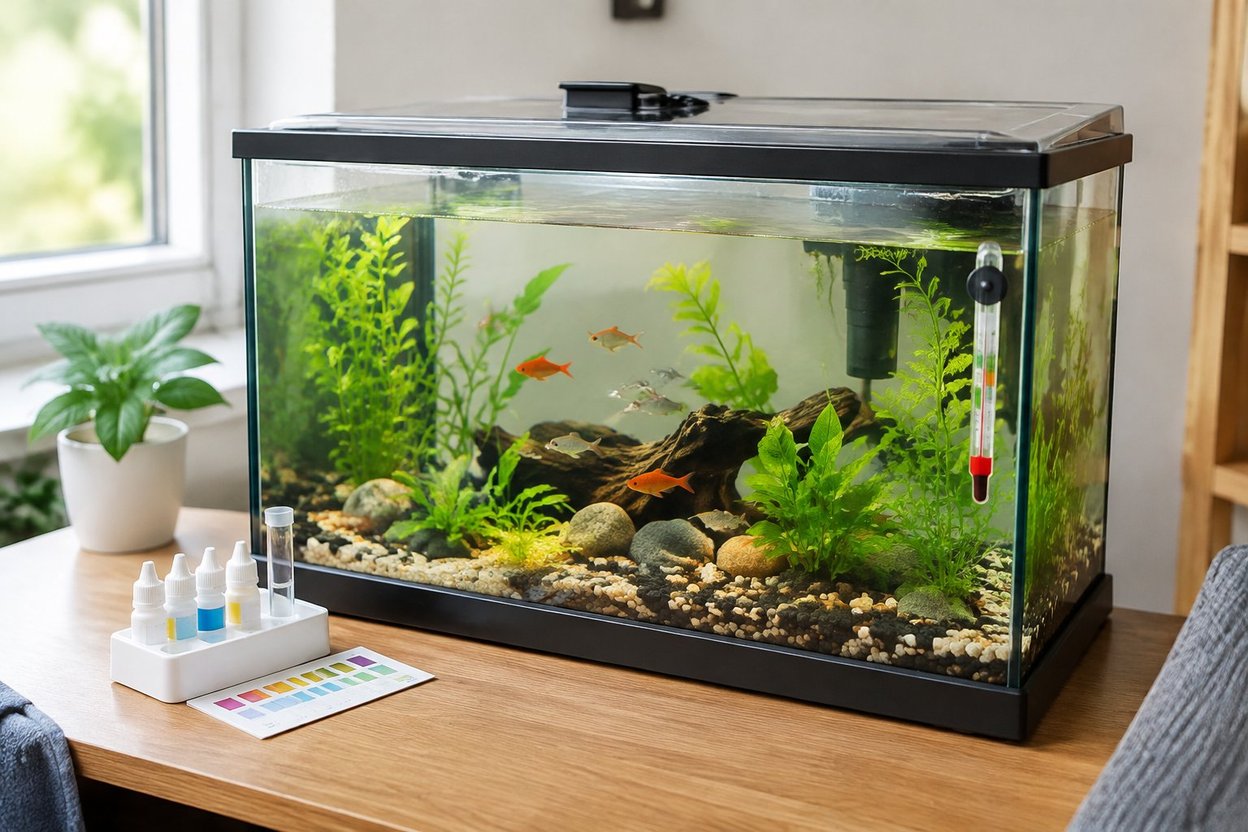
Cold slows your filter as well as your fish, so skipping a water change is risky. Learn to test ammonia, nitrite and nitrate before you decide.
Jack·8 min read·November 27, 2026
It's mid-October, and the room the tank sits in feels a few degrees cooler each morning. Your fish are moving slower and leaving food in the bowl, and you start to wonder whether you could skip this week's water change, and maybe the next one too. Short answer: cold buys you less time than it seems to. The fish make less waste, but the bacteria in your filter slow down too. In a lightly stocked, mature tank you might stretch to a few weeks. Your test kit decides that, not the thermometer or the calendar.
My rule is simple. I test before I skip. If the readings are good, I skip. If I haven't tested, I don't skip.
The usual guidance doesn't change much with the seasons. One common guide suggests about 10% a week for many tanks. It suggests 25% for small or heavily stocked tanks, and 20–30% every one to two weeks for lightly stocked planted tanks. That's the baseline in July and it's still the baseline in November.
Can you go longer? Sometimes. Sera, the German aquarium-products maker, says a 60 cm tank (about 24 inches, roughly a 15–20 gallon tank) can go three weeks without a water change "if basically everything is alright." By that they mean no disease, well-conditioned fish, and no problems with the stock or the water. Look at what that condition depends on. It depends on the tank's health, not on the weather.
No good source gives a safe number of weeks without a water change at a given cold temperature. Cold doesn't tell you the answer. Your readings do. In a healthy, lightly stocked tank where ammonia and nitrite stay at zero and nitrate climbs slowly, two or three weeks between changes is reasonable. In a crowded tank it isn't, whatever the temperature.
Here's the reasoning behind skipping. Cold fish eat less, so they make less waste, so the water stays cleaner. The first two parts are true. LiveAquaria says goldfish and pond-fish metabolism starts to slow around 55°F.
The catch is that the filter slows down too. LiveAquaria says that below 60°F the bacteria in your filter are "also slowing their activity." It recommends testing regularly to make sure ammonia and nitrite aren't showing up. A lab test of aquaculture filter media found ammonia was converted slowest at 10°C (50°F) and best at 30°C (86°F). So less waste goes in, but less of it gets processed. The two effects partly cancel out.
There's some real good news in cold water. Ammonia comes in two forms, and only the un-ionized form is very toxic. Cold water keeps more of it in the safer form. At pH 8.0, about 1.3% of total ammonia is the toxic form at 6°C (43°F). That rises to 3.8% at 20°C (68°F) and 7.4% at 30°C (86°F). At pH 7.0 the toxic share is only 0.13% at 6°C. That helps, but it isn't a free pass. Your test kit measures total ammonia, and with the filter running slow, the total can still build up.
One more point helps a mature tank. A wastewater study found that bacteria living as a film on surfaces still removed ammonia well at 8°C (46°F). That's a sewage plant, not a fish tank. It does suggest that an established filter, with a good film on its media, may handle cold better than a brand-new one.
Whether you get any extra slack depends on what kind of tank you're running.
Unheated goldfish and coldwater tanks get the most. Their water actually cools down, so the fish really do slow. LiveAquaria's steps for pond fish work for indoor coldwater setups too:
Feed less and less waste goes in. LiveAquaria also points out that fancy goldfish gulping food at the surface can end up with swim-bladder trouble, so it recommends slow-sinking food. Fish that aren't eating still produce some ammonia, though. A koi keeper on one forum keeps doing 10% weekly through the winter for exactly that reason.
Heated tropical tanks and river tanks are a different case. If your heater holds the water at 76°F, the fish don't know it's November. They eat, they make waste, and the filter keeps working at full speed. Only the room has changed. So your normal schedule still applies. A tank like the River Tank EcoSystem I ran on a 55-gallon long, with fish, little crabs, small turtles and fire-bellied frogs all sharing the water, puts a lot of waste in one system. Turtles alone add a heavy load. That kind of mixed tank gets the least slack of all.
Stocking, feeding and plants matter more than the season in any tank. A few small fish in a heavily planted tank use up their own waste. A crowded tank fed twice a day doesn't, and its nitrate climbs faster.
You need to watch three things:
How much nitrate is too much depends on who you ask. A mainstream chart calls 0–10 ppm excellent, 20–40 ppm moderate and 80+ ppm high risk. Community tanks are often kept around 20–30 ppm, and sensitive fish like discus and stingrays under about 15 ppm.
Aquariumscience.org takes a minority view. It argues that nitrate is low in toxicity, says many hobbyists are fine at 40–80 ppm, and suggests changing about 50% every one to three months to keep nitrate under about 80 ppm. Its chronic-toxicity figures run far above what most keepers ever see. That view is contested, so I'd stay under 40 ppm. If you read lab results, note that 10 mg/L nitrate-N on a Hach or LaMotte kit equals about 44 ppm nitrate on a hobby kit like API.
Test your tap water too. Whatever nitrate it already has counts toward the total. If your tap reads 20 ppm, a water change can never get the tank below 20, and you start with less room before you hit your limit.
A practical plan: test weekly through the cold months. Note how much nitrate rises each week. Schedule your change before it reaches your ceiling.
Through the holidays, a quick test is easy to fit in while the house is busy. Cold may give you a little extra time between water changes, but test first to make sure you have it.
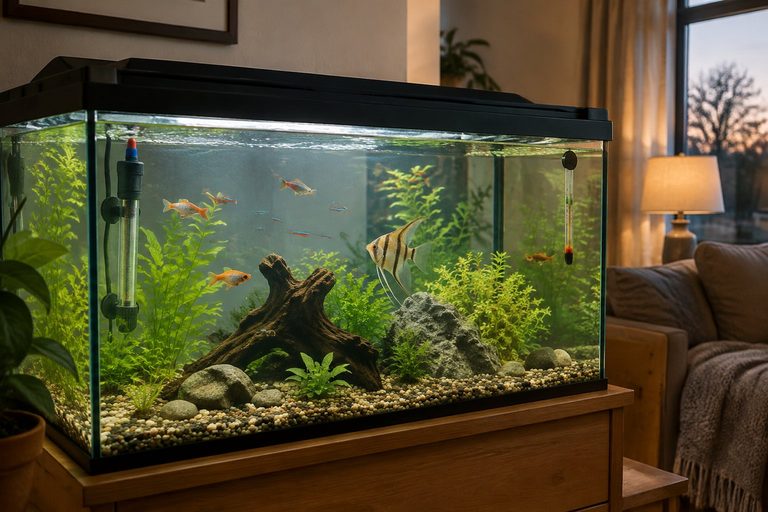
Usually, leave the heater alone. Learn why, which risks matter most while you're away, and a simple plan by trip length.
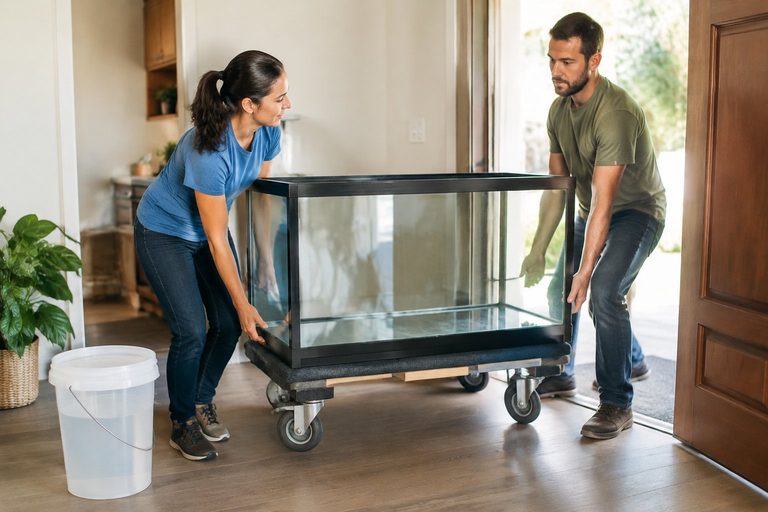
Move your aquarium without losing fish: bag them safely, keep filter bacteria wet, carry the tank empty, and test ammonia after the move.
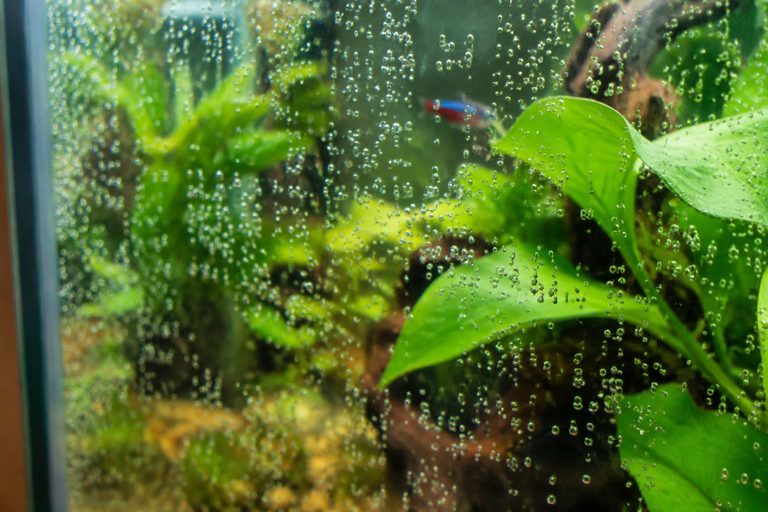
Tiny bubbles after a winter water change are usually dissolved air. Learn how to tell air from a real problem and prep refill water.