River Tank SetupLife is like a riverStart here
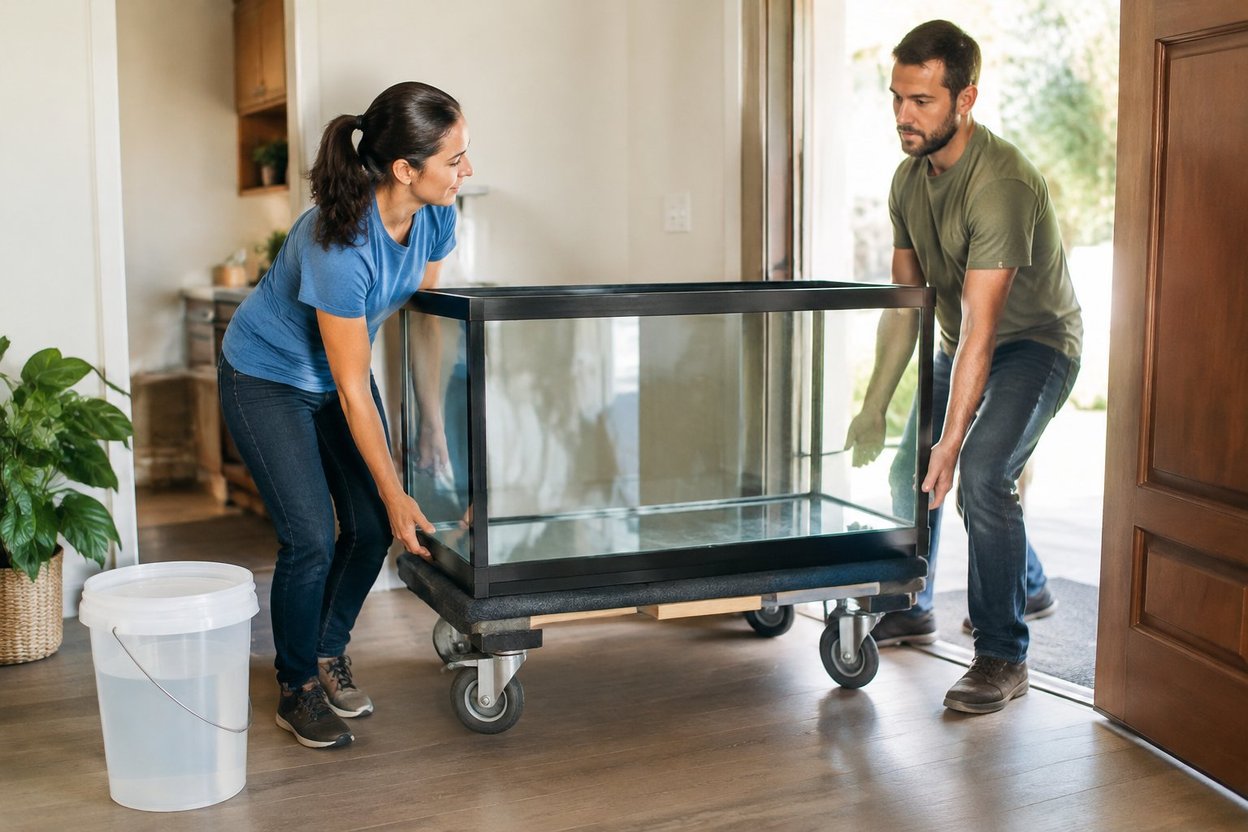
Two people carefully carrying an empty glass aquarium on a dolly through a doorway, with a lidded bucket of tank water beside them.
Tank Care

How to Move a Fish Tank Without Losing Your Fish

Move your aquarium without losing fish: bag them safely, keep filter bacteria wet, carry the tank empty, and test ammonia after the move.

Jack·12 min read·November 26, 2026

You've signed the lease, the boxes are taped, and then you look at the tank: the fish, the plants, the filter that took weeks to get established, all of it sitting in water that weighs more than your couch. Here's the short answer. Move the fish separately in bags or aerated containers. Keep the filter media and other surfaces that hold bacteria wet. Carry the tank completely empty. If you do those three things and plan the timing, most home tanks get through a move fine. The rest of this guide covers how to do each step and what to do when the day goes wrong.

The three rules, and why the tank has to be empty

1. Fish travel on their own. They never ride inside the tank.

2. The biological filter travels wet. It lives on filter media, gravel, rock, plants and decorations, not mainly in the water.

3. The tank travels empty. Aqueon says never to lift or move an aquarium with water or gravel in it, whatever its size.

The third rule comes down to weight. Born To Move notes that 55 gallons of water alone weighs more than 450 pounds, before you add the glass, substrate or equipment. My first serious tank was a 55-gallon long, so that number hits home for me. Water also sloshes, which puts strain on seams that were built to hold still water on a level stand, not a load bouncing around on a dolly. Some movers' booklets say tiny tanks of five gallons or less can go with fish and water inside. Aqueon disagrees, and so do I. Empty is the safe default.

Saved water and saved bacteria are two different things

This is where most moving guides get muddled. Many say to save the old water because "it holds the cycle." That's not where the cycle lives.

Aqueon explains that nitrifying bacteria turn ammonia into nitrite and then into nitrate, and that ammonia and nitrite are both highly toxic to fish. Those bacteria live on surfaces: filter media, gravel, rocks, plants and decorations. Keep those surfaces wet and the cycle survives. Let them dry out, or rinse them in chlorinated tap water, and you may be starting over.

Saving old tank water does something else. It gives your fish water chemistry they're already used to. Aqueon suggests saving roughly 75 to 80 percent of it. Other guides say anywhere from 50 to 80 percent. Treat those numbers as one company's advice, not a survival threshold. The real goal is that the fish don't land in water that's very different from what they left. That's why the destination check below matters as much as the buckets you haul.

How to protect the bacteria in practice:

  • Sponge and filter media ride submerged in tank water in a clean, lidded bucket. If a sponge needs a rinse, Angi says to use aquarium water, never untreated tap water.
  • Gravel, rock and decorations stay damp in their own buckets.
  • Live plants stay wet. Bag them or bucket them with a little tank water.

Before moving day: prepare the destination

One to two weeks out

  • Test the water at the new place. Aqueon says to compare its pH and alkalinity with your current tank. If they're very different, you'll know to rely more on saved water and to acclimate more slowly.
  • Book the elevator. In a condo or high-rise, AT Movers warns that the elevator reservation can set the whole schedule for the aquarium. A missed slot means more hours with fish in bags, so treat it as part of fish care.
  • Check what's legal where you're going (see the last section). This matters most if you're crossing state lines.
  • Gather clean containers. Public Storage says not to use any bucket or bin that has ever held cleaners, chemicals or household products. Buy new five-gallon buckets with lids and label them "fish only."

One to two days out

  • Make conditioned water at the destination. Aqueon recommends having at least 25 percent of the tank's volume ready, dechlorinated, a day or two ahead.
  • Stop feeding. Aqueon says to withhold food for 24 hours before the move, and some guides say up to 48. Less food means less waste in the bags.

Supplies list

  • Fish bags (double them up) and rubber bands, or lidded buckets
  • Battery-operated air pump(s)
  • An insulated cooler or styrofoam box to hold the bags
  • Clean lidded buckets for media, substrate and saved water
  • Siphon, nets, towels
  • Water conditioner and a test kit (ammonia, nitrite, pH)
  • Moving blankets, foam or bubble wrap, and tape
  • Your phone, for photos

Moving day: tear-down in order

  1. Take photos first. Aquarium Service Finder recommends photographing plumbing and equipment before you disconnect anything. Get pictures of the hoses, the cords and your aquascape, so rebuilding takes minutes instead of guesswork.
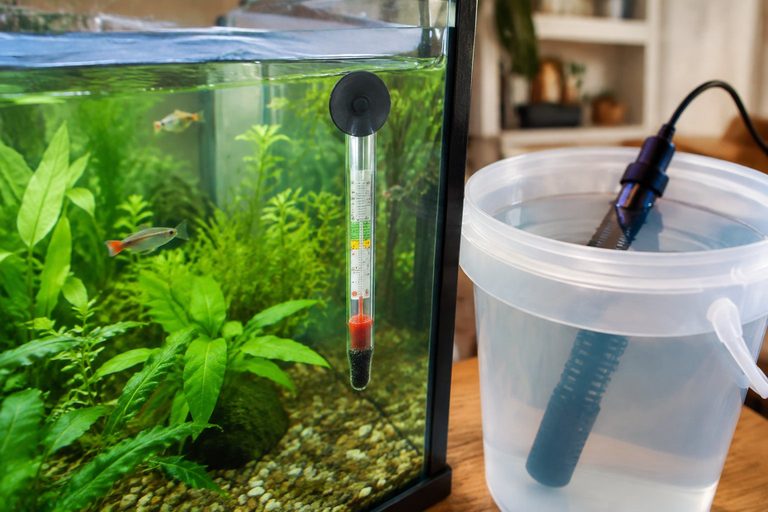
  2. Unplug the heater and let it cool. Aqueon says to wait 30 minutes before you take it out. A hot heater pulled from water can crack.
  3. Bag the fish (next section) while the water is still clean, before you stir up the substrate.
  4. Remove plants and decorations into wet buckets.
  5. Siphon out the water into clean buckets for saving.
  6. Move the filter media into a submerged bucket.
  7. Scoop out the substrate into its own damp buckets. Don't leave it in the tank.
  8. Dry and pack the empty tank.

Packing the fish

The bag recipe. Aqueon gives two options: one-third water and two-thirds air, or equal amounts of water and pure oxygen. Some guides tell you to fill bags two-thirds with water. That's backwards. The air space is the fish's oxygen supply. Double-bag every fish so one puncture doesn't empty the bag.

When to use buckets and pumps instead. Aqueon recommends battery-operated air pumps for large fish, long drives or hot weather. A big cichlid or pleco doesn't fit a bag well anyway. A lidded bucket with tank water and an airline through the lid works better.

Keep the fighters apart. Imperial Movers says to separate aggressive fish for the trip. Stressed fish in a small space take it out on each other.

Crabs, frogs and other escape artists. Back when I kept crabs and fire-bellied frogs together in a river tank, I learned fast that crabs get out of almost anything. That's why I swapped the light kit for a full screen lid. Whatever container they travel in needs a lid that actually latches, plus damp surfaces and some air. Their needs differ from fish, so check guidance for the exact species before you pack them like fish.

Shrimp, reef livestock and big plumbed systems are outside what a single bagging method can cover. Shrimp are sensitive to water changes, and saltwater systems add another layer of chemistry. A tank with custom plumbing or heavy rockwork is exactly the case Aquarium Service Finder flags for professional help.

On the road

  • Fish ride in the cabin, Extra Space Storage says, never in the trunk or cargo area. In fall the car cabin is also the place where you control the temperature. Put the bags in a cooler to buffer temperature swings and keep them dark and still.
  • Overnight stops: bring the fish indoors with you. Don't leave them in the vehicle (Extra Space Storage).
  • The empty tank: LiteMovers recommends a rigid aquarium crate, or standing the tank upright, padded and braced, in your own vehicle. Angi warns against packing hard or heavy items inside it, because they can shift and break the glass. Fill it with towels or nothing at all.

A planning guide for travel time. There's no universal "bags are safe for X hours" figure. Fish size, how many are in each bag, temperature and oxygen all change the answer. Count the total time from tear-down to fish back in a running tank, not just the drive.

  • Short local move, small peaceful fish: double bags in a cooler work well.
  • Large fish, warm weather, or several hours: aerated buckets with battery pumps.
  • Aggressive fish: separate containers, whatever the distance.
  • Overnight stop: aerated containers, brought indoors.
  • More than about six hours, or many fish from a big tank: U-Pack suggests calling a specialist fish relocation service. Treat that as their point to bring in a pro, not a survival guarantee.

If you're moving over Thanksgiving week, plan for traffic and add time to every estimate.

Arrival: rebuild before the fish go in

  1. Inspect the tank. Angi says to check it for cracks and chips before you add any water.
  2. Set it on its stand, level, where it will stay. Once it's filled, it isn't moving again.
  3. Add the substrate, then hardscape and plants.
  4. Refill. Use your saved water, topped up with dechlorinated water (Extra Space Storage) from the batch you prepared days ago. If you use aquasoil, Angi suggests pouring onto a paper plate laid on the substrate so the water doesn't blast it into a cloud.
  5. Put the media back in the filter and start everything up. Run the filter and heater, and confirm the water flows and the temperature is back where your fish live before anyone goes in. "Wait an hour" is less useful than checking the thermometer yourself.
  6. Acclimate. Extra Space Storage suggests floating bags for 20 to 30 minutes to match temperature. If the new water's pH or alkalinity differs a lot from the old (you tested in week one), go slower and mix tank water into the bag gradually.
  7. Lights off. Aqueon recommends leaving them off for several hours. Some guides say lights on, but a dark tank calms fish that have just been moved.
  8. Feed lightly. Start back slowly the next day so you don't push a disturbed filter.

The move isn't over for a few days

A water droplet with a pH symbol, representing aquarium water testing
Related: Ammonia, Nitrite, Nitrate: Reading Your Test Kit

The step most guides skip: **test ammonia and nitrite three to five days after the move**, as Aqueon advises. A filter that lost some bacteria in transit often shows it a few days later, not the first evening. You want both readings at zero. If either one shows up, do a partial water change with conditioned water, hold back on food, and test again until it clears.

When the plan breaks: delays, boarding, movers and storage

  • Closing date slips or the tank arrives cracked: don't rush into putting the fish back in a tank you don't trust. Set up a temporary home first, such as a clean, lidded, aerated tub with the media, a heater and conditioned water. Do this before you start rebuilding the main tank.
  • Boarding at a fish store: Cary's Moving recommends a signed agreement that spells out what the store is responsible for. Don't assume a shop takes on every risk.
  • Hiring movers: many will take the tank but not the fish. Meathead Movers, for example, moves empty, well-packed aquariums but doesn't transport pets. That's a company policy. Plan on carrying the livestock yourself or hiring a fish specialist.
  • Storage units: Public Storage bans fish, live plants, water-filled tanks, wet substrate and wet aquarium materials from its units. Dry equipment only.

Check the law at your destination

A fish that's legal where you live now may not be legal where you're going. Minnesota DNR lists Misgurnus anguillicaudatus as a prohibited invasive species, and it's sold under three names: dojo loach, weather loach and weatherfish. You can own a "weather loach" for years and never realize it's the same fish. Texas Parks and Wildlife says it's illegal to possess or transport listed harmful aquatic species without a permit. Its examples include water hyacinth and Australian redclaw crayfish, so the rules cover plants and invertebrates, not just fish. Those are two examples, not a complete list. Look up your destination state's wildlife agency rules using the scientific name of each animal and plant you keep. If something turns out to be prohibited, rehome it through a store or another hobbyist. Never release it.

The one-page checklist

  • [ ] Destination pH and alkalinity tested
  • [ ] Elevator or building access booked
  • [ ] Species legality checked at the destination
  • [ ] New, chemical-free buckets labeled
  • [ ] At least 25% of tank volume in conditioned water ready at the new place
  • [ ] Feeding stopped 24 hours ahead
  • [ ] Photos of equipment and plumbing
  • [ ] Heater unplugged and cooled for 30 minutes
  • [ ] Fish double-bagged (1/3 water, 2/3 air) or in aerated buckets; aggressive fish separated
  • [ ] Media submerged; substrate and decor damp
  • [ ] Tank empty, padded, braced upright, nothing heavy inside
  • [ ] Fish in the cabin; brought indoors at any overnight stop
  • [ ] Tank inspected for cracks before refilling
  • [ ] Equipment running and temperature confirmed before the fish go in
  • [ ] Lights off for several hours
  • [ ] Ammonia and nitrite tested on days 3 to 5
Sources (15)