Why Does Aquarium Water Evaporate Faster in Winter?
Winter heat dries indoor air and speeds evaporation, so your tank loses water faster. Learn how to measure your loss and slow it down.
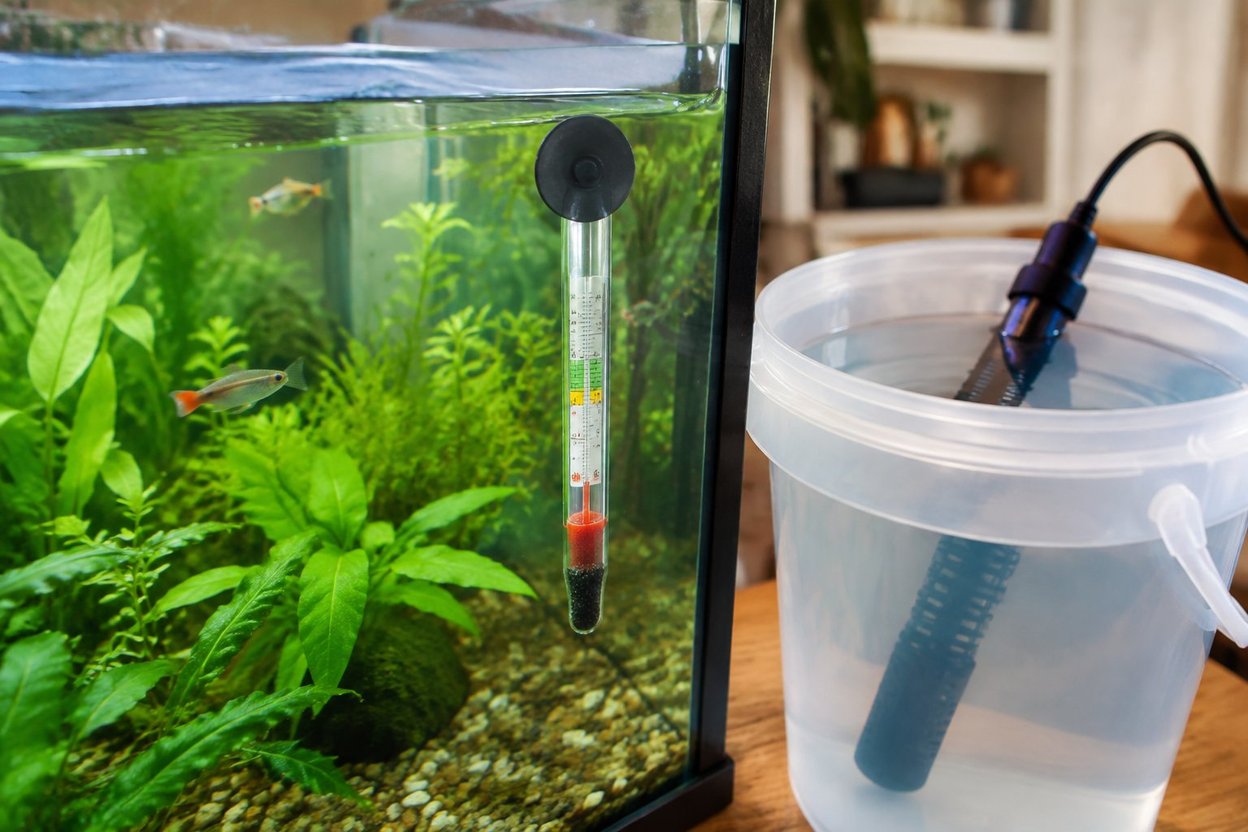
Warm and treat replacement water to match your tank's temperature before a winter water change, and measure it instead of guessing by feel.
Jack·7 min read·November 23, 2026
It's a cold fall evening and you're at the sink with a bucket, running the tap until the water feels "about right" on your wrist. Touch can't tell you whether the water matches the tank. Here's how to do it properly. Read the aquarium's temperature with a thermometer. Prepare the new water in a separate container and warm it with its own aquarium heater until it reads as close to the tank as you can get it. Treat it, check it one more time, and only then refill.
Good aquarium guidance agrees that new water should match the tank's temperature as closely as possible before it goes in. The RSPCA suggests a simple way to do that: put a separate aquarium heater in the replacement water and warm it first.
Here's the order I'd follow before every winter water change:
One honest caveat: the guidance says to match closely, but it doesn't give a safe gap in degrees that works for every species, every amount of water and every refill speed. I won't make one up. Treat "as close as you can measure" as the goal, not "within a few degrees."
Match what the thermometer in the tank reads, not what the heater dial says. A heater setting doesn't tell you the water's actual temperature. Only a thermometer does, which is why both Aqueon and the RSPCA call it essential equipment.
It also matters what that reading should be in the first place. The right temperature depends on the species you keep. A stream-style tank shouldn't automatically get the standard tropical setting just because it's an aquarium. My old River Tank held fish, little crabs, small turtles and fire-bellied frogs. A mixed setup like that needs each animal's own requirements checked, and those needs aren't all the same. If your tank is holding at a temperature that suits everything living in it, that reading is your target.
If the reading looks wrong, like several degrees off from where the tank normally sits, don't match it. Find out why first: a failing heater, a cold draft from a window, a thermometer that's slipped. Copying a bad number into your replacement water just carries the problem forward.
You need four things:
Set up the batch well before you plan to drain anything. Warm the water, check it, and give it more time if it isn't there yet. How long that takes depends on the volume, the heater and how cold your house is, so measure instead of trusting the clock. Don't drain the tank until the replacement water is ready. A half-empty tank waiting on a cold bucket is the situation this method exists to avoid.
Leaving a bucket out overnight doesn't solve the problem on its own. Water that sits in the room settles toward room temperature. A heated tank isn't at room temperature, and in a cool winter house the gap between the two can be real. Use the thermometer to confirm the match, not your expectations.
Where the water comes from matters too. The EPA and CDC both warn that hot tap water can carry more lead than cold, because hot water draws more out of plumbing. Their advice is about drinking water, not fish tanks, and it doesn't mean every home's hot water is unsuitable for an aquarium. Even so, my recommendation is to start with cold tap water and warm it with the aquarium heater. That's a precaution, not an official aquarium rule.
Warming the water and treating it are two separate jobs, and doing one doesn't cover the other. Warm tap water still contains whatever disinfectant your utility uses. Chlorine is harmful to fish and to the beneficial bacteria that keep your tank cycled, so replacement water needs treatment before it goes in.
Many US water systems use chloramine instead of chlorine. The old trick of letting a bucket stand overnight doesn't work there. The EPA says letting water stand does not remove monochloramine. Use a conditioner that handles both chlorine and chloramine, and dose it exactly as the label says for your volume. Doses differ between products, so the bottle in your hand is the one to follow.
OATA lists both steps, preparing the water to the right temperature and treating it, as part of routine freshwater maintenance. Get both done before the bucket reaches the tank.
Water changes are when heaters get damaged. The tank's water level drops, a heater ends up in open air, or someone pulls a hot one out and drops it into cold water. Follow your heater's own instructions before you drain, expose, move or restart it.
For an example of what those instructions look like, Aqueon tells owners of its heaters to unplug the heater and wait at least 30 minutes before taking it out of the water. After putting it back, wait at least 30 minutes before plugging it in. That's one manufacturer's guidance for its products. Your model may say something different, so check yours.
Placement matters once the tank is refilled. Aqueon notes that water moving around the heater spreads the heat evenly. In a stream layout full of stones and driftwood, it's easy to tuck the heater into a dead corner behind the hardscape, where it heats one pocket and leaves the far pools cooler. Put it where the current actually flows past it.
To finish, read the tank thermometer and confirm the heater is running and fully underwater. Check again later. Both the RSPCA and Aqueon advise regular thermometer checks even with a heater that has a thermostat.
If the prepared water still reads too cold or too warm, fix it in the container and measure again. Don't add it and plan to "correct" the tank afterward. Sudden, large temperature changes stress fish, and that includes changes made to fix an earlier mistake. Cranking the tank heater up or dropping in cold water to undo a bad refill just creates a second swing.
If your fish act strangely after a water change, check temperature and water quality before guessing at the cause. The RSPCA notes that slow swimming can point to cold stress in tropical fish. Gasping at the surface can mean too little oxygen or poor water quality. Behavior alone won't tell you which problem you have, but the thermometer and your test kit can. If problems continue or fish look ill, contact a vet with fish experience.
Quick checklist before the next cold-weather change:
Winter heat dries indoor air and speeds evaporation, so your tank loses water faster. Learn how to measure your loss and slow it down.
Keep a cold-room tank from freezing: size the heater for the room, add a lid and insulation, and plan for power cuts.
Fish eat less as water cools, but heated tropical tanks need no change. Get temperature-based feeding guidance for unheated tanks and ponds.