How long can the fish go without food over a four-day Thanksgiving trip?
Healthy adult fish can usually go four days without food. Learn which tanks need a plan, why overfeeding is riskier, and what to check before you leave.
Going away for Thanksgiving? Learn when fish can skip feeding, how to set a light timer, and what to tell a tank sitter before you leave.
Jack·8 min read·November 18, 2026
Thanksgiving is Thursday, November 26, and you're probably leaving Wednesday night and getting back Sunday. Sometime before then you'll look at the tank and wonder who's going to feed the fish. For a healthy adult tank, nobody has to. Four days without food is safer for most fish than four days of extra food. You still need to set the light timer, and you need to decide whether anyone checks in. If you do want a feeder, it has to be tested first.
For a trip of about four days, most healthy adult fish need little or no food. Aqueon says that over a two- or three-day weekend, "virtually all fish" except newly hatched fry can go without eating. Aquarium Co-Op says that for a week or less, the easiest plan is not to feed at all. They've seen fish go seven days straight without food in their quarantine tanks, and they've handled thousands of fish. NC State's vet school, writing about power outages, says most fish can survive days or even weeks without food.
Hunger isn't really the danger. Uneaten food rots, ammonia climbs, and the tank can crash while you're gone. Aquarium Life Hub says the risk comes "almost entirely from adding food, not from withholding it." So don't give a big meal on the way out. Feed what you normally feed and stop there.
Some tanks are different. Fry, very small fish and very active fish need food more often than large, older carnivores. Crabs, frogs and reptiles aren't fish, so they get their own section at the end.
Here's the rule of thumb. For trips under about a week, skip feeding. For trips longer than about a week, use a feeder you've tested or a sitter with meals already portioned out.
You'll find two kinds of products: automatic feeders and vacation blocks.
An automatic feeder holds dry food in a hopper and turns it on a timer. Battery models run on a set schedule. Aqueon notes that budget models feed every 12 hours. Aquarium Co-Op sells its own feeder that can feed up to four times a day, gets 3 to 6 months per battery charge, and lists for $39.99.
Feeders have three known problems:
If you're going to use one, run it at home for several days first on the smallest portion. Aquarium Life Hub suggests a full week. Watch how much actually lands in the water and whether it gets eaten. If you start the test now, in early fall, you'll have plenty of time before the holiday.
Skip vacation blocks. Aquarium Co-Op blames them for "ammonia spikes and algae blooms." Aquarium Life Hub says they dissolve unpredictably and can cloud the water and raise hardness. If you use one anyway, Aqueon says to test it a week ahead to make sure your fish will even eat it.
The food question is settled, so turn to the light. If your light doesn't have a timer, add one before you go. Aqueon and App Aquatic both recommend it. A plain plug-in timer works fine. What matters is that the light comes on and goes off at the same time each day, and doesn't stay on for four days or stay off for four days.
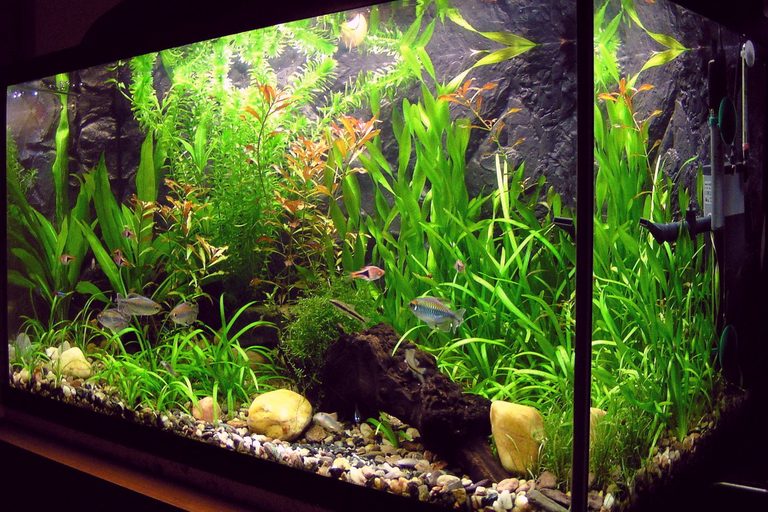
Many aquarium LEDs have timer modes built in. An 8-hour setting is common, usually alongside options like 4, 10 or 12 hours. These modes repeat on a 24-hour cycle. My advice is to keep the hours you already run, because the fish and plants are used to that schedule.
A steady light schedule matters more in a river tank. The riparium plants rooted in the water, the moss on the stones and the look of the whole stream depend on regular light. Set the timer at least a few days before you leave and make sure it actually switches on and off on schedule. Also check that the time is still correct after any power blip.
For four days, nobody has to come by. App Aquatic recommends a sitter for trips of two weeks or longer, and Aquarium Life Hub says from about eight days. Still, having someone look in is a reasonable backup, especially if the neighbor is already feeding your cat.
If someone does come, set them up so they can't overfeed:
Give them a short checklist so they know what matters:
Leave your phone number next to the list.
The goal is a stable tank that has settled by the time you leave, not one you just disturbed.
Water change and filter. Sources disagree on timing and size. Aqueon suggests 25% about a week before a longer trip. Aquarium Co-Op says to clean a couple of days ahead and be done 48 hours before you go. Aquarium Life Hub suggests a larger change 2 to 3 days out. App Aquatic says 40 to 50% one to two days before. A sensible range is to change 25 to 50% somewhere between a week and two days before you leave, and to do any filter maintenance early enough that the tank has a couple of days to settle.
Test. Check ammonia, nitrite and nitrate. You want ammonia and nitrite at zero and nitrate where your tank normally sits. Confirm the heater holds its temperature.
Hold off on changes. Don't add fish or décor in the two weeks before the trip. Aqueon says to avoid any major change for a month. If there's a new fish you've been planning on, buy it after the holiday.
Power outage note. November storms happen. NC State's vet school says tropical fish can tolerate the low 60s °F, or even the high 50s, for several hours. If ammonia goes above 1 ppm after an outage, they recommend a 10 to 30% water change. Mention this to your sitter.
When you get home, look over every fish for injuries or signs of disease and count them. Test the water, do a water change in the next few days and service the filter. Aqueon gives this advice for trips of a week or more, but it's a good habit after four days too. Then go back to normal feeding with normal portions.
This is where the "skip feeding" rule may not hold. The fish advice above is well supported. Good numbers for how long fiddler crabs, African dwarf frogs or small reptiles can safely go without food are hard to find. Some of these animals may need food more often than fish, but I won't give a day count I can't back up. Look up your species in a reputable care guide before you decide. If it calls for frequent feeding, plan on a sitter with portions ready.
One thing I can tell you from my own tank: crabs and some reptiles get out of almost anything. That's why I replaced the light kit on my old River Tank with a full screen lid. Before you leave, check every gap, cord notch and corner. If an animal escapes, nobody will be home to find it.
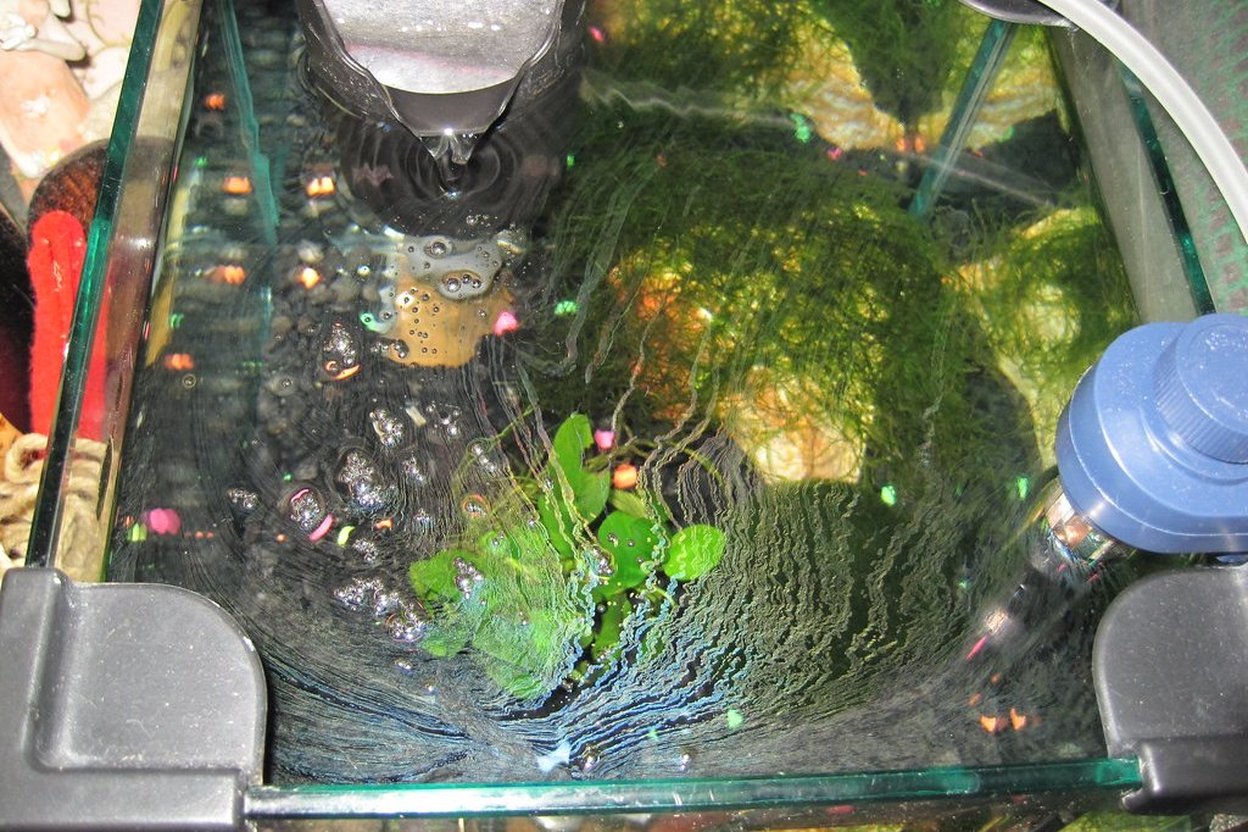
Photo: Strange growth on aquarium surface by distar97, BY 2.0.
Healthy adult fish can usually go four days without food. Learn which tanks need a plan, why overfeeding is riskier, and what to check before you leave.
Yes, holiday lights can go outside an aquarium. Learn the electrical safety rules, heat limits, and timer setup that keep fish safe.
Find out whether your pond fish can stay outside or need to come indoors in November, and how to set up a cold tank and move them safely.