A riparium is a tank with a shoreline. What you actually need
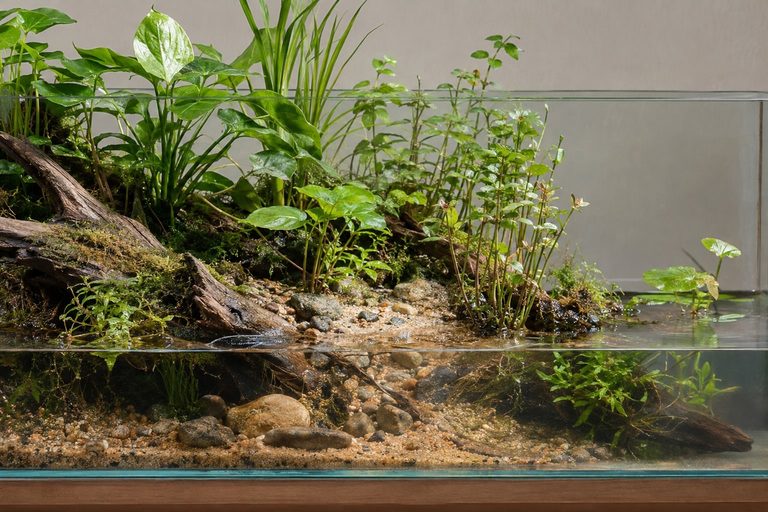
Learn what a riparium is and what you need to build one: an open-top tank, planters, plants that tolerate wet roots, and light above the water.
Discover why whole pumpkins damage aquarium water and how to safely offer small pieces as seasonal treats.
Jack·9 min read·October 8, 2026
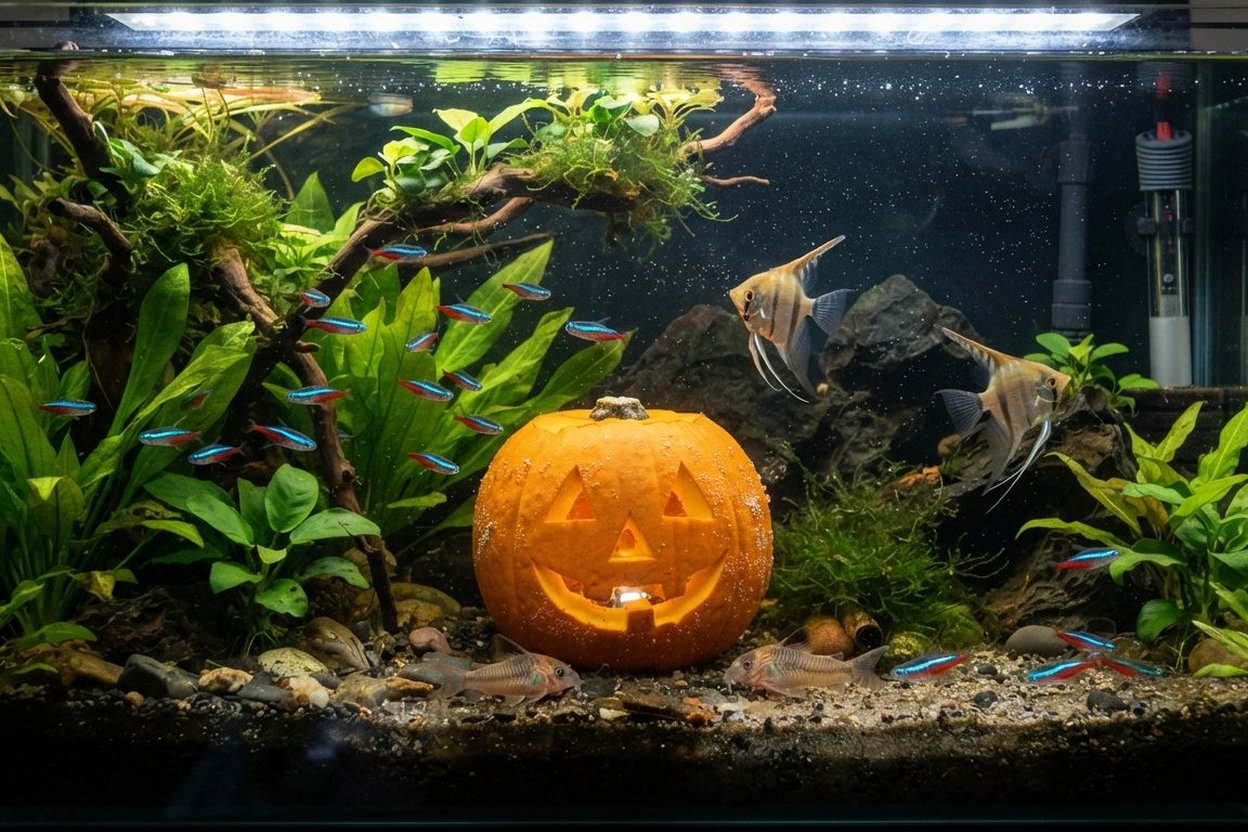
Every October someone puts a carved pumpkin under water, and a photo of it ends up in your feed. Your tank is right there, so you start to wonder whether a little jack-o'-lantern would look good next to the driftwood, and whether the fish would nibble it. Here's the short answer: don't put a whole pumpkin in a home tank. It rots, it eats up oxygen, and it pushes up ammonia, and that hits every animal in the tank. The only reasonable use is a small piece of plain flesh, offered as a treat and taken out the same day.
Underwater pumpkin carving is real. Public aquariums do it. This October the Tennessee Aquarium is running diver carving demonstrations at 2 p.m. on five Saturdays in its River Journey building, and fish swim around the divers while they work. Back in 2014, divers at Sea Life at the Mall of America carved pumpkins underwater too. Their aquarists said the pumpkins and the cut pieces float, so the divers had to hold everything down. Some fish ate the bits that drifted off. The staff also cleaned the seeds out ahead of time so the seeds wouldn't clog the pumps.
That's a short, supervised show in a huge system, run by staff who pull everything out afterward. A pumpkin sitting in your 55-gallon is a different thing. It stays in the water, it floats, and it breaks down in a small volume of water that every fish, shrimp and snail has to live in. A small, clean piece of flesh can work as a same-day treat, and I'll get to how. The whole pumpkin stays on the porch.
Raw pumpkin flesh is mostly water. USDA figures per 100 grams of the edible part are 91.6 g water, 6.5 g carbohydrate (2.76 g of that is sugar), 1.0 g protein, and 0.1 g fat. That makes it an easy meal for bacteria. When they break it down they use oxygen, and as the flesh decays it releases ammonia.
Both of those problems hurt fish. University of Florida extension says fish are healthiest at 5 mg/L dissolved oxygen or more. Most are distressed at 2 to 4 mg/L, and they usually die below 2. Warm water makes it worse because it holds less oxygen to begin with: about 7.4 mg/L at saturation at 90°F, compared with 11.9 mg/L at 45°F. Warm fish also need more oxygen because their metabolism runs faster.
Ammonia comes in two forms in water. The un-ionized form (NH3) is about 100 times more toxic than ammonium, and the share of that form goes up as pH and temperature go up. Above 0.05 mg/L, un-ionized ammonia can damage tissue. Fish exposed to lower levels over time grow poorly and pick up infections more easily. Nitrite, the next step in the breakdown, is toxic at levels as low as 0.10 mg/L.
You may come across EPA's freshwater ammonia criteria: 17 mg/L total ammonia nitrogen as a one-hour average and 1.9 mg/L as a 30-day average, both at pH 7 and 20°C. Those are recommendations for rivers and lakes, and they aren't a safe reading for your tank. Snails and freshwater mussels are part of the reason EPA tightened those limits in 2013. In a home aquarium the target is simple: no detectable ammonia. Florida extension, API and Fritz all agree that any ammonia at all means something is out of balance. Ammonia has no color or smell, even at levels that harm fish, so only a test will show it.
Those USDA numbers are for 100 grams of edible flesh. A carving pumpkin is a lot bigger than that. In a 2024 University of Maine trial of 20 jack-o'-lantern varieties, average fruit weight ran from 12 pounds up to 27.3 pounds, and single fruits weighed anywhere from 5 to 34 pounds. Not all of that weight is flesh, because you also have rind, seeds and string. It's still a huge load of rot for a home tank.
It also doesn't last long, even in air. Kansas State horticulture specialist Cynthia Domenghini says a carved pumpkin can show rot in just a few days, and a week at most. A real candle speeds that up because its heat cooks the inside. Every cut surface you make opens up more wet flesh to bacteria.
Inside a tank, the leftover parts cause their own problems. Loose seeds and stringy pulp drift into the filter intake, and even Sea Life, with a big public system, cleaned the seeds out to protect its pumps. A floating pumpkin also bobs around in the current. In a river-style tank, where a pump carries water across and down through the pools, that's a mess spread through the whole system.
A pumpkin's rind has a natural waxy coating, and it usually comes home with field dirt on it. FDA says to wash produce under running water and scrub firm produce with a clean brush. Don't use soap or produce wash, because produce is porous and can absorb it. Washing cuts down bacteria but doesn't get rid of them.
People also "preserve" jack-o'-lanterns. K-State's porch advice is to soak the carved inside for several hours in a 10 percent bleach solution. That's fine for the front step, but it's a chlorine bath you'd be bringing into your tank. API says chlorine and chloramine are highly toxic to aquatic life and can destroy gill tissue. That's the same reason you condition tap water before a water change.
A plastic or painted pumpkin from the craft aisle isn't automatically safe either. No one tells you what its coating is made of or what it releases under water. Invertebrates are usually the first to suffer when metals get into the water. In a Kentucky State University study, half of the juvenile freshwater prawns died within 48 hours at just 0.46 mg/L copper sulfate. That study wasn't testing ornament paint, but it shows how little it takes to harm the shrimp and snails in your tank.
If you want to give your fish a seasonal treat, here are the limits I'd stick to:
This is hobby practice, not a studied diet. Most of the reports are about plecos and goldfish. On FishLore, a keeper warned that pumpkin's natural sugars can cause a bacterial bloom if leftovers aren't removed quickly, and set a limit of 24 hours followed by a large water change. On a Reddit thread, someone who used to carve a small pumpkin for plecos and fancy goldfish said it made enough of a mess that they needed several water changes. One person there mentioned shrimp eating it. I wouldn't count on any of that for frogs, crabs or turtles. Nothing solid backs it up, so I don't offer pumpkin to them.
Remember that the tank is shared. The piece your pleco ignores rots in the same water your shrimp and frogs live in. In my old river tank, fish, little crabs, fire-bellied frogs and small turtles all shared one body of water, so anything fouling one pool fouled the whole tank.
If you want an autumn feel, use material that's meant to go in the water. Dried Indian almond (catappa) leaves and driftwood slowly release tannins, which tint the water amber like a woodland creek. As the leaves break down they grow biofilm that shrimp and fry graze. Aquarium Co-Op suggests one 4- to 7-inch leaf for every 5 to 20 gallons. Expect the leaves to float for the first 3 to 7 days. Most last a month or two, and you can add a new one when the old one gets holes. Rinse dusty leaves, but don't boil them, because boiling leaves the tannins in the pot. Skip leaves for high-pH fish like African cichlids and many livebearers.
If you really want a pumpkin shape, buy one sold for aquarium use. Make sure it has no glitter or flaking paint and no hole a fish, shrimp or crab could get stuck in. Keep the real pumpkins for carving on the porch and for Thanksgiving pie.
Learn what a riparium is and what you need to build one: an open-top tank, planters, plants that tolerate wet roots, and light above the water.
Learn which Halloween ornaments are safe in a fish tank, why craft-store decor is risky, and a simple screening test before adding one.
Which leaves are safe in a fish tank, how many to use, how to collect and prep oak leaves, and which trees to skip.