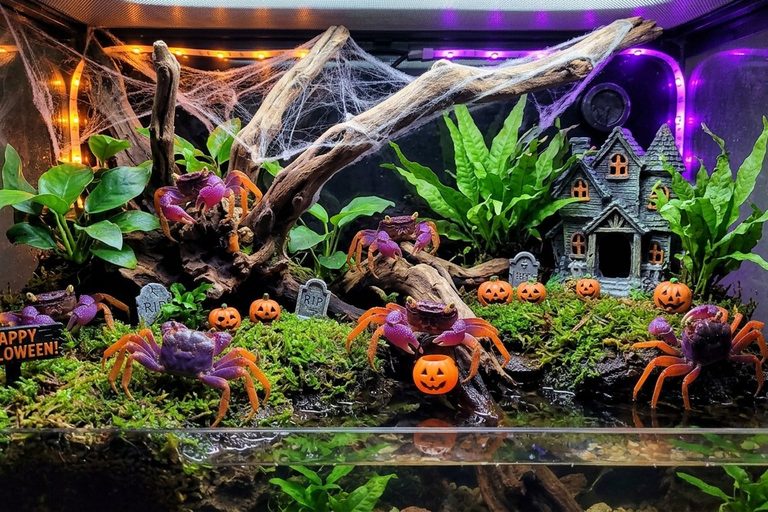
Can a crab get stuck in a pumpkin-house ornament?
Can a crab get trapped in a pumpkin-house ornament? See which openings are risky, how to pick or seal a safe piece, and how to free a stuck crab.
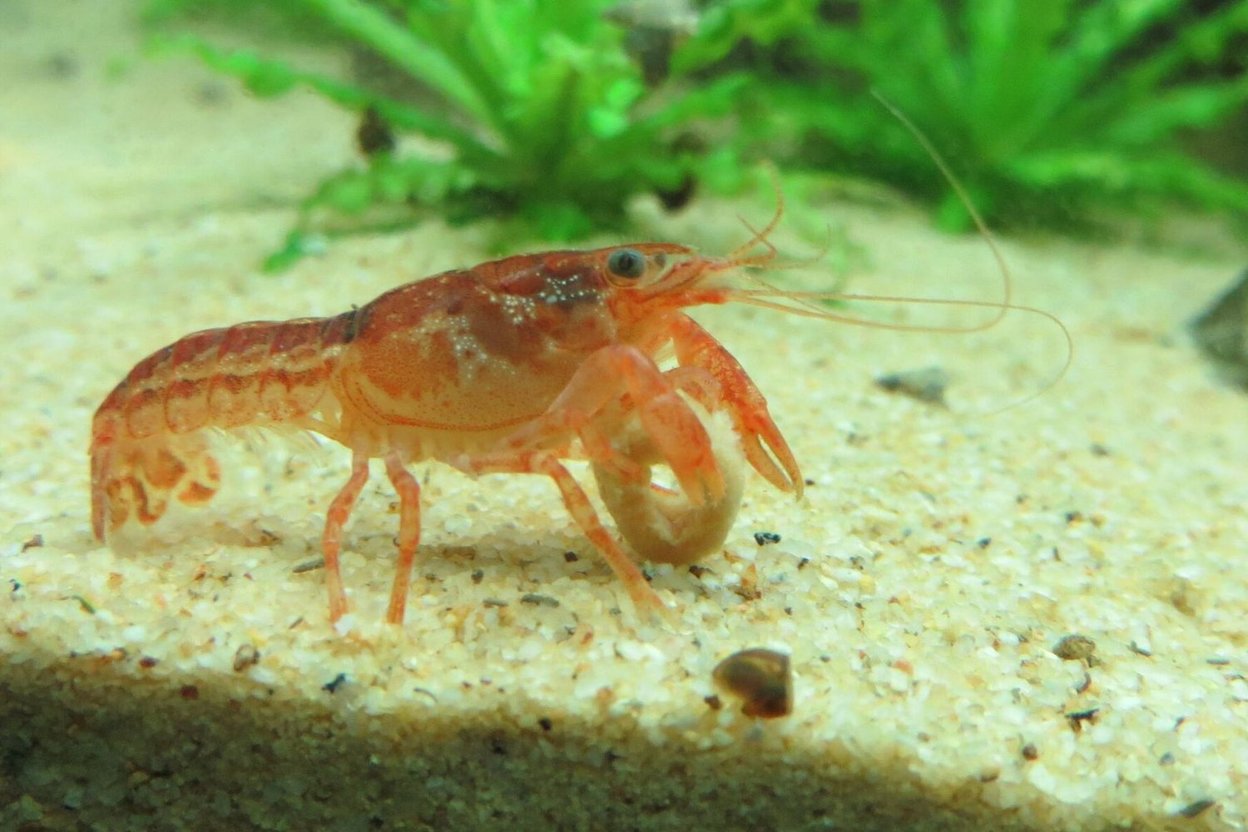
CPO dwarf crayfish care: size, temperature, safe tank mates, molting, breeding, how much flow they like, and the states where you can't buy them.
Jack·8 min read·October 6, 2026
The CPO (Cambarellus patzcuarensis 'Orange'), also sold as the orange dwarf Mexican crayfish, tops out around 1.5 to 2 inches with its claws. That's too small to catch healthy fish, so it fits in a community tank where a regular crayfish would be a problem. Give it a 10-gallon or bigger tank kept at 60 to 75°F, hard water, plenty of caves, and a calm spot away from strong current. It will live about 2 to 3 years.
There are two exceptions. A CPO will still eat dwarf shrimp, small snails and very small or sick fish if it can catch them. And it's illegal to own in some states, so check yours before you order.
In our post on whether crayfish can live with fish, the general answer was "usually not." Most aquarium crayfish, like the electric blue (Procambarus alleni), grow to 4 to 6 inches. They have claws big enough to grab a sleeping fish off the bottom and strong enough to shred plants.
A CPO is a different animal. Adults measure 4 to 5 cm (1.6 to 2.0 inches) including the claws, and plenty stay closer to 1.2 to 1.6 inches. Their claws are about the size of a grain of rice. A healthy danio or White Cloud can easily get out of reach.
The orange color comes from an aquarium mutation. Wild C. patzcuarensis are brown with gray or blue tints, and the orange form is rarely found in the wild. The species is native to one small area in Michoacán, Mexico: Lake Pátzcuaro, sitting at about 6,700 feet (2,035 m), plus a few nearby springs. The IUCN lists it as Endangered. Every CPO you see in a store comes from tank-bred stock.
Caves matter more than anything else here. Give each crayfish at least one hiding spot, and add a few extra. Short lengths of 3/4-inch PVC, small clay pots on their side, stacked flat stones and the gaps under driftwood all work. If there are fewer caves than crayfish, they spend the day fighting over them.
This crayfish comes from a lake, not a river. It does fine with a gentle current, but it doesn't want to stand in a torrent all day.
In a one-way manifold river tank, keep CPOs at the outflow end where the water slows down. You can also stack rocks to make a still pocket behind them. If a crayfish keeps getting pushed across the sand or wedges itself in a corner, the flow is too strong where it lives. Plants that grip rock, like java fern and anubias, break up the current and give it cover.
Always put a sponge pre-filter on the intake. Juvenile CPOs are the size of a grain of rice and will get pulled straight into a powerhead or filter.
Good matches:
Risky:
Bad matches:
In a fish tank, plan on 1 male and 2 to 3 females per 10 gallons, and add rock work and caves for every animal. Males are more likely to spar over territory.
Crayfish grow by shedding their whole shell. Juveniles molt often and adults less. For a day or two afterward the new shell is soft, the crayfish can barely defend itself, and it hides.
What that looks like and what to do:
The same rule from crayfish keepers covers ammonia and nitrite: they hit inverts harder than fish. Only add CPOs to a fully cycled tank, and check it with a test kit for the first few weeks.
CPOs are scavengers and eat almost anything that reaches the bottom. A simple routine:
In a tank with fish, make sure some food actually reaches the bottom. If the fish get all of it, the crayfish start hunting for something else. For the bigger picture, see what crayfish eat.
Keep a male and a female together in a cool, settled tank and you'll probably get babies. The female carries up to about 60 eggs under her tail. When the eggs turn dark they're fertilized, and they hatch in roughly 3 to 4 weeks.
There's no larval stage. The young come out as tiny, complete crayfish and feed themselves from day one. Crayfish are cannibals, though. In a tank full of fish and adults, few young survive unless there's thick moss or a pile of leaf litter for them to hide in. If you want more, move the female with eggs to her own 5- or 10-gallon tank with a sponge filter.
As of October 2026, US online sellers list single CPOs for about $11 to $21. Trios and breeding groups run about $35 to $50, and a female carrying eggs costs around $30.
Check the law before you buy. Several states restrict non-native crayfish, and one major US breeder won't ship CPOs to Arizona, California, Maine, Pennsylvania, Virginia, Washington, or Wisconsin. Pennsylvania restricts nearly all live crayfish. Other states ban only certain species, like marbled or red swamp crayfish, and the lists change. Check your state's fish and wildlife rules first. Never let a crayfish loose outdoors, in any state.
Can a crab get trapped in a pumpkin-house ornament? See which openings are risky, how to pick or seal a safe piece, and how to free a stuck crab.
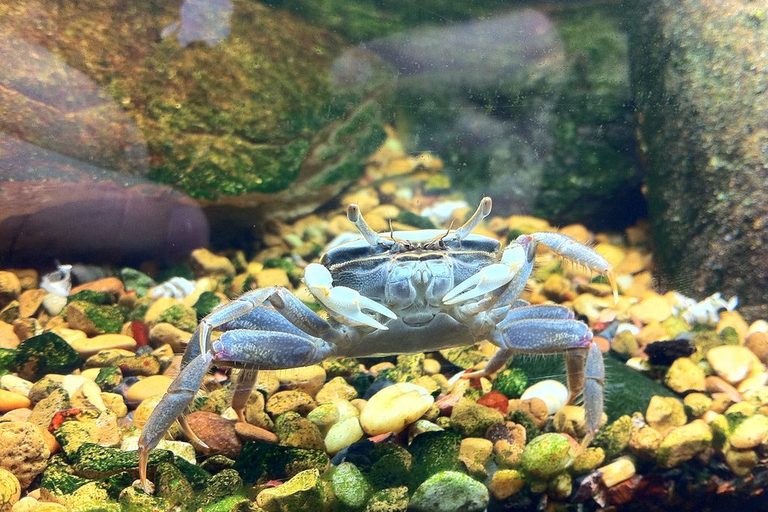
Vampire crabs make tempting Halloween impulse buys at $10, but they need a land-heavy paludarium to survive—not a traditional fish tank.
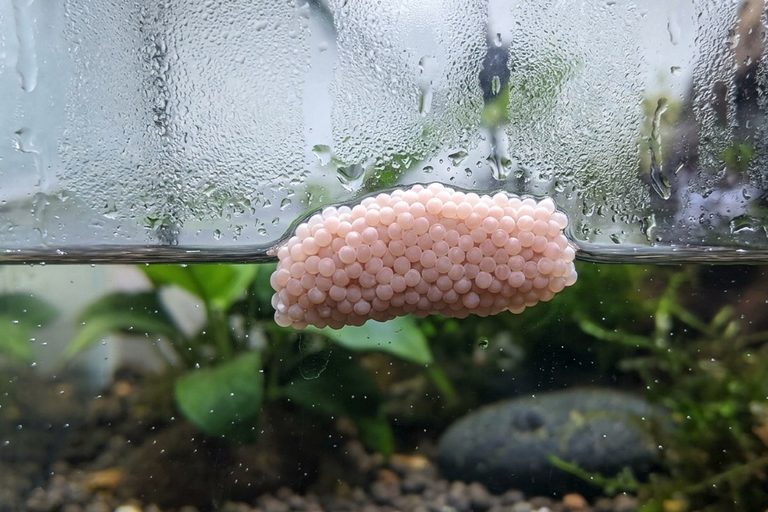
Tell snail eggs apart by species (nerite dots, mystery snail clutches, ramshorn and bladder jelly) and decide whether to scrape, keep, or hatch them.